Showing posts with label Systems. Show all posts

Wednesday, January 8, 2025

Organisational GRIT

Many people wonder, "What's the difference between a successful organisation, and one that struggles?"
Throughout my decades of consulting and observation, I have observed four factors that I call "GRIT."
Take heed of these, and you're most likely in good shape. On the other hand, ignore these at your own risk.
Organisational GRIT Goals Improvement Tomorrow Relationships Foundational Transactional Future-Oriented Immediate

The GRIT Factors

When analysing what's going on in a company, there are four factors at play that create GRIT - in healthy organisations, these are naturally tended to and require little effort.

However, unhealthy systems of work neglect one or more of these, with dire consequences:

Goals

The first factor of a healthy system of work is that people have clear goals: things we want to achieve in the future. That can be the personal goals, team goals, business goals.

Best case, everyone has all of these - and all of them align.

Worst case, people have no goals, in which case they will show up just to get paid.

The worst case scenario lends itself to all kind of doomsday scenarios for a business owner: nothing getting done, people wasting their time with unfruitful conflict, or people leaving to make more from their life.

Relationships

The second factor of a healthy system of work is that people have positive relationships with the people around them. That includes their team, other departments, business partners and customers.

Best case, everyone has sustainable, sufficiently close relationships that make their network resilient.

Worst case, people's relationships are toxic or adversarial.

I don't think it requires further explanation what happens when the customer is treated like an enemy - but many organisations seem to be entirely oblivious to the cost in time, effort - and ultimately money - that is wasted with infighting.

Improvement

The third factor of a healthy system of work is that people continuously pursue improvement at all levels: make work faster, easier, better. Reduce risk, friction, cost. Make customers happier. Go home with less stress and more happiness.

Best case, the system of work makes that a natural part of the work, and everyone actively contributes.

Worst case, processes and tools deteriorate and everyone is looking the other way.

It's easy to figure out what happens when improvement is not part of people's thoughts or actions, but that's the reality in many organisations: The tyranny of the Urgent makes improvement fall over the edge until the cost of fixing things has reached frightening levels, and people are scared to even get started.

Tomorrow

The fourth factor of a healthy system of work sounds very abstract - "tomorrow" - so let me make it a bit more tangible: Tomorrow, a competitor may arrive on the market. Your business model may get disrupted. A key player in your team may move on. Are you prepared?

Best case, the company is constantly and persistently putting efforts into being prepared for the uncertainties and inevitabilities of tomorrow, and people are not scared to look into the future.

Worst case, everyone knows that the business is heading downhill, but people close their eyes to this uncomfortable reality. And with every day, the looming specter of Tomorrow becomes more threatening.

It doesn't take a lot of imagination where a company is headed when they have no plans for Tomorrow. And yet, few can articulate a clear plan.

Building GRIT

Building a company with GRIT is easy if that's how you've always done it. But if you've never done it, it's staggeringly hard. In fact, it seems insurmountable. So I'll give you a few pointers for getting started on the journey of building GRIT.

  1. Itemize the most important Challenges, Opportunities and ongoing Activities in each sector.
  2. If a sector has few or no items in it, it's a blind spot. Take some time to think!
  3. Ask yourself, "How can we improve our situation?"
  4. Take action on the first item and see where it leads you.

Now, that wasn't hard, isn't it?

From now, you may frequently revisit your GRIT matrix, see what pops up and whether you're making progress.

By taking GRIT building serious, you will see a significant reduction in risk, stress and fear - and significant boosts in sustainability, employee satisfaction and business outcomes.

Give it a try!

Sunday, September 24, 2023

No, performance isn't defined 94% by the system.

There's a persistent myth proliferating in the Agile space: allegedly, "94% of an organization's performance is attributed to the system, while only a mere 6% depends on the individuals." This widely circulated belief shapes perceptions about the dynamics of productivity, teamwork, and leadership in countless organizations - but: it's false. And here's why.

The 94% myth

Could it really be the case that we can hire individuals without ambition, experience, or talent and expect nearly identical results as we would from a team of motivated, skilled, and dedicated professionals? Does the concept of "systems over individuals" hold up in the real world of work, where unique skills, passions, and contributions of individuals often drive innovation and excellence?

The reality is more nuanced than the oversimplified notion of 94% versus 6% in performance. To understand what's going on, we must first trace back to the origins of this myth in the writings of W. Edwards Deming, the renowned statistician and quality management guru, and dig out the roots of this quote. In doing so, we'll discover that he wasn't making a case that individual performance is almost irrelevant - to the contrary!

What's the "System?"

Let's start by defining what "the system" actually is - let's take a look at what the systems thinker Russell Ackoff repeated on multiple occasions:

A system is never the sum of its parts; it’s the product of their interaction.
Russell Ackoff

Before we explore deeper, let's sprinkle in a quote from Dan Pink on organisational systems:

  • Autonomy: the urge to direct our own lives.
  • Mastery: the desire to get better and better at something that matters.
  • Purpose: the yearning to do what we do in the service of something larger than ourselves.
These are the building blocks of an entirely new operating system for our businesses.
Dan Pink, "Drive"

While we can formidably argue whether Pink's statement is an assertion, anecdotal evidence or fact - what matters it that Dan Pink sees within the individual the building blocks for a better organisational system.

Out of the Crisis

Let's now explore what Deming actually wrote:

I should estimate that in my experience most troubles and most possibilities for improvement add up to the proportions something like this:
  • 94% belongs to the system (responsibility of management)
  • 6% special
W. Edwards Deming, "Out of the Crisis" (p. 315)

As you can see: what he mentioned isn't that performance is (almost) exclusively attributed to the system, but that most of the problems are systemic and require active management attention.

Untangling system and individuals

Let's use these definitions to untangle what "the system" is, versus what "individuals" are in our context:

The System

As Russell Ackoff aptly stated, a system is not simply the sum of its individual components; rather, it emerges as the product of their intricate interactions. In the context of organizational performance and management, "the system" encompasses the collective structure, processes, culture, and interdependencies that define an organization. It represents the holistic framework within which individuals operate, a complex web of relationships, rules, and practices that determine the organization's overall effectiveness and outcomes.

The Individual

Drawing from Dan Pink's insights, "the individual" embodies the human element within the organizational context. It's the unique person, with their aspirations, skills, motivations, and contributions. Within the organization, "the individual" serves as the driving force behind the building blocks of autonomy, mastery, and purpose. Autonomy represents the urge to self-direct, mastery is the pursuit of continuous improvement in meaningful skills, and purpose signifies the desire to contribute to something greater than oneself. These qualities collectively define the individual's role in shaping and enriching the organizational system.

The misconception

If '94% of the performance can be attributed to the system, and only 6% to the individual' -- then we could hire people without ambition, experience, or talent and get almost identical results as we would get from hiring people who care for what they do, know what they do, and are excellent at what they do. However, that's a massive misconception which is only possible due to a conflation of terminology which tries to separate "the system" from "the people making up the system" (which doesn't work!) - The people making up the system are the basis of the system! And a system comprised of autonomous, highly qualified, purpose-driven individuals has a different basis than a system where these are missing!

The System's Role

According to Russell Ackoff's definition, "the system" encompasses the intricate web of interactions and interdependencies within an organization. It includes organizational structure, processes, culture, and more. If we were to take the 94% attributed to the system at face value, it might suggest that the organization's performance is almost entirely determined by these systemic factors. This perspective can lead to the misconception that individuals are replaceable, and hiring decisions are inconsequential.

The Individual's Role

On the other hand, Dan Pink's insights highlight the critical importance of individual motivation, skills, and purpose in driving performance. If we consider individuals as mere cogs in the system, the statement implies that their personal qualities and contributions are almost irrelevant. However, if that were the case, that contradicts the notion that individuals require autonomy, mastery, and purpose within the organizational system!

Shaping effective systems

Great systems of work are shaped by motivated, gifted individuals who interact and collaborate to maximize the entire system's performance. They uplift one another, and won't tolerate being dragged down by someone who neither can, nor wants to contribute.

A high performing system of work is synthesized by optimizing the interactions of the individuals therein, while carefully paying attention that individuals wo have no place within that system don't get to negatively impact the Drive of those within.

Imperfection

Everyone can have a bad day. Even a bad week or month. And we all have our strengths and weaknesses. And nobody's omniscient. That's not what we're talking about.

But when you go out claiming that it doesn't matter whether people are qualified or motivated - you're sending an utterly destructive signal: It means that you don't respect those who put in the hard work, the learning, and the passion.

So: just don't.

You can only build great systems from people who pursue autonomy, mastery and purpose.
And you can't let people who have neither interfere with them.

Disagree?

Maybe you will disagree.

But unless you'd be fine getting major surgery from a belligerent teenager who doesn't even want to learn how to make a proper incision - I hope you're not seriously going to claim that most of the performance is in the hospital, and the surgeon themselves is neglegible to your health.

Wednesday, November 9, 2022

There's always a bigger context!

Have you wondered why so many people, organizations - and even humanity as a whole, constantly find themselves in a mess that's hard to scramble out of?

The reason is quite simple: because we are quite short-term oriented, and we either don't see - or discount - the bigger context we're acting in!


Virtuous Cycles

When we want something that we don't have (or: not enough from), we change something in a way that we predict that we'll get what we're looking for. We then see if that did work, and we'll continue doing more of that until we have enough. And we do the opposite when we don't want something that we do have. 

Feedback loops help us to pause, stop or course correct while we're at it.

A trivial example of a virtuous cycle might be lunch: When we're hungry, we want food. We get our portion, like it, and eat some more. (If we don't like the food, we might get something else instead.) We continue eating until either our portion is gone, or our stomach signals "Full."


Vicious Cycles

A vicious cycle isn't the direct opposite of a virtuous cycle - it's when we do something, and get something we don't want. For example, if we'd really like that wild honey, and put our hand into the beehive: the longer we leave our hand in there, the more we'll get stung.


Short term and long term

In the short term, we complete one action and observe the immediate results. For example, we grab a candy bar, and it satisfies our craving. We can repeat this cycle again and again, and we get predictable and repeatable results (well, until our stomach tells us we had too much candy.)

In the long term, however, we get other results than in the short term: while one candy satisfies our craving, one hundred days of repeated snacking will lead to some weight gain, and two years' worth of snacking will result in a wobbly tummy.

Thus, the virtuous cylce of "craving satisfied" is embedded in a vicious cycle of "gain weight."


Inseparability of cycles

In our simple example, it's impossible to separate the short-term virtuous cycle from the long-term vicious cycle: as the proverb goes, "you can't have your cake and eat it, too." The action that starts the virtuous cycle will also set the vicious cycle in motion. 

The desirable short-term outcomes of the virtuous cycle are immediately visible, so we're tempted to set it in motion. On the flip side, the long-term outcomes of the vicious cycle are invisible at the moment, so we're tempted to discount them in favor of the proven and tangible short-term benefits.

Shocking consequences

We find ourselves continuously repeating the virtuous cycle, with the firm belief that what we're doing is beneficial, until - one day, in our example, we get a Diabetes diagnosis: It's impossible to attribute the diabetes to any single piece of candy we consumed. Even worse: simply stopping the virtuous cycle of meeting our craving isn't going to change the situation we're in, and the process of reverting the vicious cycle will be difficult to impossible. There's no easy "undo" action related to anything we did in the past.

We were caught by the embedded larger context of our visible virtuous cycle: the invisible vicious cycle.


What does our little example imply for a software organization, then?

What you see isn't what you get!

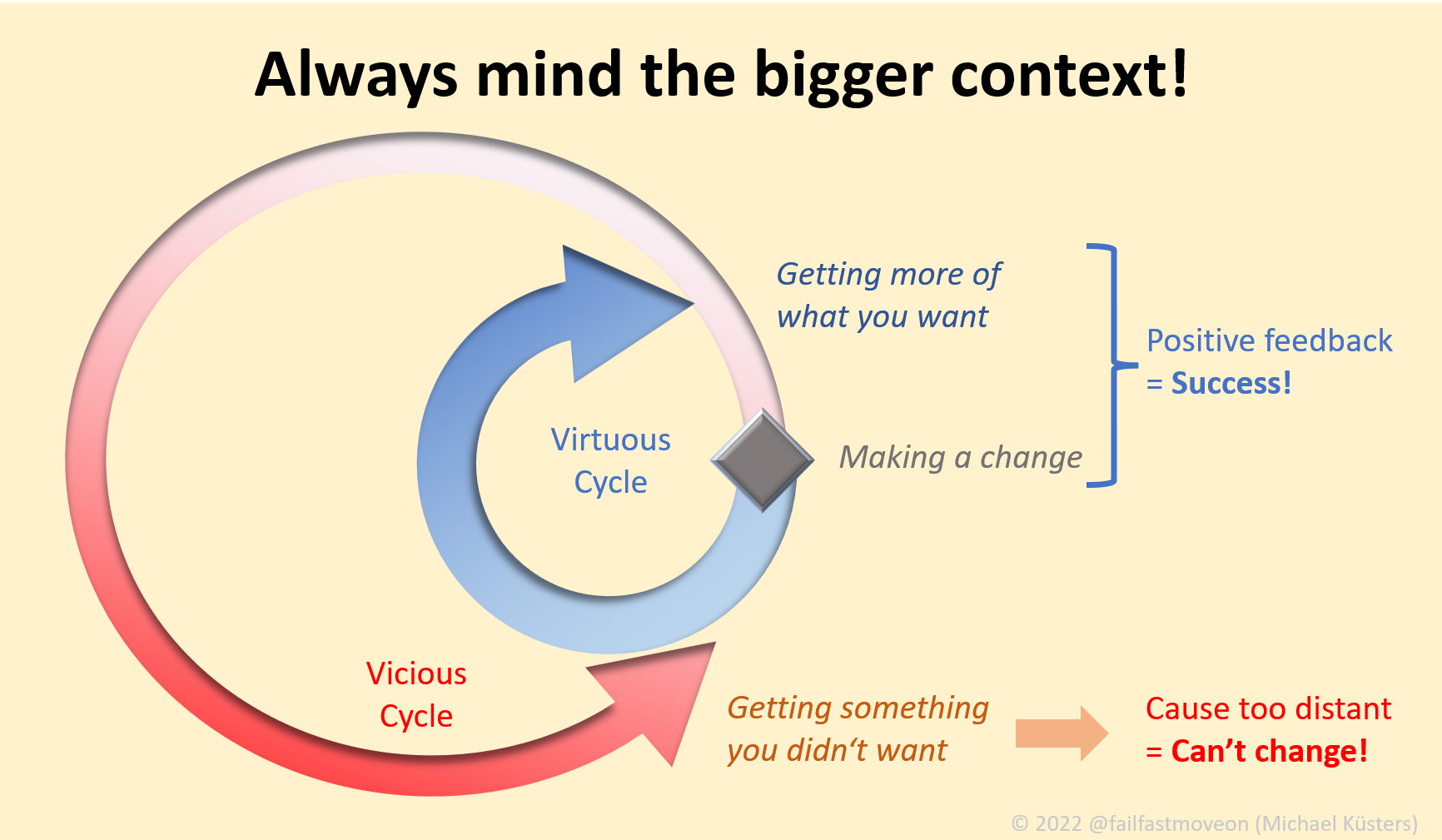
Take a look at this diagram which illustrates the larger systemic context we may find ourselves in:


We always get positive feedback from our immediate action, so we learn that our action is good.

For example, let's say the developer who's always fastest (by skipping tests) learns that they get praise by customers and management, whereas the developers who are always slowest (by building quality in) learn that they'd get more appreciation by cutting short on quality.

The short-term virtuous cycle is that developers learn how to deliver faster and meet tight deadlines.

Unfortunately, by the time we realize the effects of the vicious cycle, our product is probably almost dead: it might take months, possibly years, to trace out and fix all the bugs in the code, and that's not even calculating the effort (and frustration) of adding tests to an unmaintainable codebase.

And worse than that, we only have developers left who have - over the years - learned that building quality in is bad for their careers.

By the time we've come to realize that the vicious circle has taken over, there's no quick fix any more, and the cost of change, at this point in time, is overwhelming.


Scrambling out of the mess

When we realize that we got something that we don't want, we have a myriad of problems to address:

  1. We must discover a way to re-wire the outer vicious cycle by disrupting it, and replacing it with a vicious cycle.

  2. We must become conscious that the presumed virtuous cycle did spin off a vicious cycle, and must stop triggering more of the vicious cycle.

  3. We must un-learn and stop the old virtuous cycle, despite the visible short-term benefits.
    This step is very hard, because we must actively reject the benefits we attributed to it.

  4. We must actively pursue the new virtuous cycle, despite it being slow, and the benefits being less visible than the benefits of the old virtuous cycle. This requires strong discipline, because it's easy to lapse into old habits, potentially eliminating months of progress with a single act of carelessness.

Unfortuntately, since we saw short-term benefits in the past, we tend to look for a new way that undoes all of the damage caused by the vicious cycle in the blink of an eye: instead of actively doing the hard work of behavioural and belief change, we often hunt for a miracle pill. And thus start another vicious cycle.


Let me put it like it is:

If a physical building has collapsed because it was built using poor materials, you can't just swallow a pill to rebuild the entire thing. The only way forward is to clean up the rubble, get better materials, and construct a more stable building.


And that's how you get sustainable change:

  1. Become clear what got you into the bigger mess.
  2. Stop doing that, even if it gave you results you were looking for.
  3. Clean up the shambles.
  4. Create something new that avoids the vicious cycle.


Tuesday, May 31, 2022

Why we need clearly defined goals

 A common issue I observe in many organizations - there's no visible goal beyond, "Get this work done," and people don't even see the point in "wasting time to set a goal." The problem: many organizations are just tactical engines generating work and handling exceptions in the generated work. Yet, most of this work has no goal. Goal-setting is not an esoterical exercise, and here's why.


The Hidden Factory

One concept of Lean Management is the "Hidden Factory" - and this concept deserves some kind of explanation. A factory is an institution that applies work to input in order to generate some outputs. So far, so good. A "hidden factory," on the other hand, is a factory within a factory, doing work without generating viable outputs: either nothing - or waste.

To understand the problem of hidden factories, think like a customer.

You get the option to buy your product from one of two providers.

Company A has a straightforward process, turning raw input into consumable output, and Company B has a process that turns the same input into something, then into something else, then into something else, then into the same consumable output.

This extra work makes Provider B's product is more expensive to produce, without any discernable difference to the product sold by Company A.

Company A and Company B thus sell products which are identical in all aspects - except price. Company B has to charge a premium to cover the extra work they do. Which product would you purchase?

As customers, we do not care how much work is required to do something. Given all other things equal, we choose to opt for the cheapest, fastest way of meeting our needs.

And companies are no different here. But how does that relate to goal-setting?

Induced and intermediate work

Many companies are great at inducing work - and once that work has been induced, it becomes necessary, and the people doing it must do it, otherwise the outcome can no longer be achieved.

Let's pick a practical example.
We have chosen to use a Design Process that requires any changes to be made as a sequential series of steps:
  1. Request the element to be changed
  2. Describe the change to be made
  3. Prototype the change
  4. Validate the change
  5. Implement the change
  6. Verify the change
While you may argue that all of these steps are common sense and necessary, our specific process choice has just locked us into a process that turns replacing an image into a full day's work - a change that could be done by a competent developer in a couple of minutes.

How is that relevant to goal-setting?

Confusing Task and Outcome

Referring to our fictional process, an individual may have the specific responsibility of describing changes. Their input is a change request, and their output is a change description. As a customer, I address this organization to say, "I want a new backdrop on my website." Our execution agent of step 2 will say, "I am overburdened. I have too many change requests on my desk. I need someone to help me describe the changes." If we would ask them "Why do you need to describe the changes?" - they might say, "So that they can be prototyped." If we'd press and ask, "And why do they need to be prototyped?" - the answer could be, "So that we can validate the change." - which, of course begs the question, "And then - I get what?" - "An implementable change."

You see where this is going: Everyone has reasons why they do the things they do, and from the way this organization is set up, their reasons are indeed valid. And still, nobody really understands why they do the things they do. 
We should assume that everyone whom we ask should answer, "So that you can get your new backdrop." In many companies, however, that is not the case.

And that's where goals come into play.

Goals

Every company has a few - usually very few - first-order goals, and a specific context that provides constraints within which these goals can be realized. Surviving and thriving on the market is a baseline almost all have, and most of the time, the primary goal is to achieve this by means of advancing the products which define the company. That would be an example of a first-order goal.

From that, we get into second-order goals, that is - into derived goals which help us achieve this primary goal. Build a better product. Build the product better. Sell more. Sell faster. Sell cheaper. You name it.

These, of course, would be realized via strategies - which in themselves have multiple subordinate goals. For example: Increase product quality, add features to the product, reduce discomfort with the current product, improve perception of the product in its current state - again, the possibilities are endless.

At some point in the rabbit hole, somewhere deep down in the loop of operational delivery, we may then see a business analyst stating, "I am overburdened. I have too many change requests on my desk. I need someone to help me describe the changes." - but why are they doing it? Are we describing change in order to increase product quality, in order to sell more, or to sell cheaper?
It's easy to realize that "adding people to do the work" may indeed make sense when our goal is to add features to improve our product. And yet, it seems entirely backwards when our goal is to "sell cheaper."

That's why we are setting goals. It allows everyone, on all layers of an enterprise, regardless of their specific responsibility, to quickly and easily determine, "Do the things which I am doing help us achieve our goals?"
If the answer to that simple and straightforward question is, "No" - then this begs two followup questions:
  • Why am I doing things which are not helping this company achieve its goals?
  • What do we need to change, so that I am contributing to our goals?

The impact of goals


Well-defined goals immediately expose the Hidden Factories and induced work, and they set the stage for reducing waste in our processes as well as leading employees to do more meaningful, more important work.

Poorly defined goals - such as "to do X amount of work" - encourage establishing and inflating Hidden Factories, and they set the stage for wasteful processes and unhappy employees who may be doing totally worthless work, without ever realizing.

Undefined goals - or the absence of goals - remove the yardstick by which we can measure whether we are contributing to anything of relevance or merely adding waste. Without a goal, work is meaningless and improvement impossible.


The importance of goals

Goal-setting is important for organizations both large and small in:
  1. Guiding decision-making
  2. Enabling Improvement
  3. Eliminating Waste
While a goal itself doesn't do any of these, a goal sets the stage for these. Once you know your goal, you can take it from there.

Sunday, April 4, 2021

A few things you have to understand about systems

The difference between a system and a compound is that while a compound is defined by the sum of its component, a system is defined by the product of the interactions of its components.

This very simple statement has profound consequences, regardless of whether we are talking about chemical, physical, social or entire economic systems.


Decomposition and Reassembly

Classic science has it that if you de-compose a complex problem into smaller units, the complexity can be handled in individual bites. While this works great when interactions are not as prevalent, it entirely fails when the behaviour of a system is predominantly defined by component interactions.

A de-composed system missing even one of its interactions will not display the same properties as the complete system.

Modifying a de-composed system may create an entirely different system when re-assembled.


Synchronization

Interaction generates friction. The mechanism of minimizing friction is synchronization.

As friction reduces the motion energy of the affected components, the amount of friction gradually reduces until the interacting components will have minimal friction.  As such, every interacting component of a system will enter into a synchronized state over time.

The momentum of a system in a synchronized state will be the cumulative momentum of all components. The same holds true for inertia.

Synchronization does not equate stability. Indeed, the process of synchronization could destabilize, and potentially destroy, the entire system.


Subsystems

On a higher level of abstraction, a subsystem behaves like a component, assuming its internal and external interactions are separate and distinct.

Interacting subsystems will generate friction until they are synchronized.

Subsystem synchronization could oscillate between different states and have different driving forces until an equilibrium is achieved.

Independent subsystems behave like components: they may be in sync within themselves, yet out of sync with each other.


Component Effectiveness

Since the components of a system are as effective as their interactions, the effectiveness of any individual component is both enabled and constrained by its interaction. 

Effectiveness is enabled by synchronized interactions.
Effectiveness is constrained by frictional interactions.

When a component's interactions are predominantly frictional, the component is rendered ineffective unless it's intended to be an abrasive component.


Why is any of that important?

Think about what the above means for piloting changes in parts of your system.
You may not achieve what you intend.