Showing posts with label Culture. Show all posts

Thursday, August 14, 2025

Don’t «Trust the Team» if They’re Stupid!

Yes, that title is intended to ruffle a few feathers. "Trust the team," without context - is a slogan: unhelpful, misleading, and quite often the cause of, not the solution to, greater problems.
Many people associate "Stupid" with low intellect. If you do: let me change your mind. In business, stupidity is behaviour, not IQ.

This is stupid

Imagine you’re the CEO of a company in crisis. An old friend offers a deal that could get you back on your feet.
The only catch: they need to be convinced their contribution will be valued. You assure them it will.

You arrange for them to meet your team. You can’t be there, but they’re all professionals: they’ve got this.

Then your phone rings. There will be no follow-up. The deal is off. Worse: they’ll no longer offer introductions or recommendations; it would damage their own reputation.

What just happened? Your team's actions just cost you an ally and years of relationship-building. There was no malice or sabotage. It was just plain stupidity.

People do stupid things - even with every safeguard in place. And when it happens, your role shifts instantly: from shaping the future to cleaning up the mess.

Understanding Stupidity

Half a century ago, the economist Carlo Cipolla wrote a satirical, uncomfortable essay titled "The Basic Laws of Human Stupidity" ("Le leggi fondamentali della stupidità umana", 1976)

He determined the value of actions by two factors: impact on self and impact on others. Stupidity, he said, harms both.

You may ask, "Why would anyone do that?" Which is the point: There is no reason, yet it happens, far more often than we think. And - it's stupid.

Cipolla Quadrants: Impact on Others vs Impact on Self A 2x2 matrix showing Intelligent, Helpless, Bandit, and Stupid based on benefit/harm to self and others. impact on others impact on self ↑ benefit ↓ harm harm ← → benefit Helpless people Benefit others at their own expense Intelligent people Benefit self and others Stupid people Harm self and others Bandits Benefit self at others’ expense

The Leader’s Field Guide to Dealing with Stupid Teams

Executive Lens - the "CEO Method"

Stupid teams damage the company and themselves. Deal with them in three steps:

C
ontain - Contain the blast radius and do damage control.
E
ducate - Teach, guide and provide information. Tighten feedback loops.
O
bserve - Actively monitor for change. If there's no improvement, disengage or remove the team.

Below is the full, detailed guide to fixing "Team Stupidity."

Full Guide

Locate your team in the quadrant. Lead accordingly. With the exception of the Intelligent team, move them out of the quadrant.

Helpless Teams
Indicators
  • Say “yes” → drown → miss their own deadlines.
  • Apologize to stakeholders for internal confusion they didn’t cause.
  • Work hard, little leverage; impact diffuses into others’ wins.
Contain
  • Set a single owner and cap WIP; enforce trade-offs.
  • Give permission & scripts to say “not now” without guilt.
  • Pair with an assertive peer; protect calendar from drive-bys.
Educate
  • Boundary & negotiation training.
  • Actively guide prioritization.
  • Teach cost-benefit thinking
Observe
  • Check for signs of power slopes. Level the playing field.
  • Create visibility into team outcomes.
Intelligent Teams
Indicators
  • Net-positive outcomes for team & stakeholders; few surprises.
  • Double-loop learning: they stress-test their own ideas.
  • Credit-sharing, clear handoffs, clean partner interactions.
Grow
  • Protect decision rights; remove bureaucracy and politics.
  • Feed them high-leverage problems at their competence boundary.
  • Use pre-mortems & lightweight decision logs to scale the pattern.
Keep this!
  • Don’t move them.
  • Codify playbooks; mentor others; plan succession.
  • Guide them to mentor others as well.
Stupid Teams
Indicators
  • Celebrate "wins" that produce more fallout than benefit.
  • Repeat the same error after feedback; high confidence, low grasp.
  • Create more problems than they resolve; eroding external trust.
Contain
  • Suspend outward-facing autonomy immediately.
  • Enforce brief → act → debrief with decision logs & pre-mortems.
  • Route external comms over an “adult in the room”; assign a fixer.
Educate
  • Provide context
  • Teach about consequences.
  • Coach forward-thinking.
Observe
  • Positive change: gradually grow autonomy.
  • No measurable shift: redeploy or remove. Protect the company.
  • Unsuccessful: disengage. Protect your reputation.
Bandits
Indicators
  • Local "wins" with systemic damage; stakeholders feel squeezed.
  • Information hoarding, triangulation, credit theft.
  • Success depends on optics, not durable outcomes.
Contain
  • Shift metrics to shared outcomes; add sunlight (public cause-effect dashboards).
  • Rotate ownership; enforce conflict-of-interest disclosures.
  • Close feedback loops; limit blast radius.
Educate
  • Remove incentives that put personal gain over systemic benefit
  • Tether incentives to peer and stakeholder satisfaction.
  • Redesign structure to face customer outcomes.
Observe
  • Aligned outcomes: anchor changes.
  • Misaligned outcomes: modify incentives.
  • Exploitation persists: disengage.

Stupidity is Contagious

Can't you just ignore Stupidity? No!

Uncontrolled stupidity sucks you into its blast radius at the worst moment.

And here’s the real danger: tolerating stupidity makes you stupid. Leadership turns into firefighting. Disastrous trade-offs become "pragmatic." Cut corners become "quick wins."

A single act of stupidity rarely remains alone. It triggers a domino cascade, and before long, you're no longer a leader - but cleaning up the debris.

The Leader’s Job: Damage Control

Stupidity is more dangerous to your organization than banditry. Bandits can be managed: Their moves are predictable, and can be redirected by adjusting incentives.

Stupidity, however, is an entirely different beast. It's chaotic and self-reinforcing. You can't predict what they'll do, when or how, and what it will cause. And worse: Stupidity compounds - a stupid move is often addressed by yet another stupid move.

With a stupid team, every day is risk. Challenge poor logic directly. Immediately intervene when "good intentions" cause damage. Invest in change. And when that fails, cut the ties.

Leadership doesn't mean suffering from stupidity - but to end it.

Trust the Right Teams

"Trust the team" is powerful - when the team has earned it! Trust intelligent teams. Give them space to think, act, and lead.

When you see stupid moves, stop "trusting" - actively fix it, fast and with consequence.

Stupidity has no limits. But the market's patience does.

Monday, March 31, 2025

The Castle Is Under Siege - are you the bard?

“If you focus on people being busy, you get people being busy.”

You’ve probably heard that one in some Agile training or coaching session. It sounds profound. But it’s often used in ways that are… well, wrong.

This kind of slogan gets thrown around as if it’s gospel. It’s Agile Coaching Dogma: stemming from half-understood principles and applying Goodhart’s Law in isolation.

Let’s be clear: it’s nonsense. And it misdirects.

The Castle Under Siege

Imagine a medieval castle under siege.
Enemy troops on horseback are approaching fast.
The guards are scrambling to prepare.

The defenders need bows: Everyone will be dead if the siege succeeds.

But there’s only one fletcher.

He’s already buried in work, literally stringing bows as if his life depends on it. There’s a line of guards waiting, each of them waiting for a bow. He’s clearly under pressure.

Meanwhile, his apprentice is chasing that irritating mouse which gnawed at the bread overnight.

Just at that moment, a bard arrives with a clearly urgent request:: “ My mandolin broke, and I really need you to take a look. It’s for the royal banquet tonight. The king will be very upset if there is no music!”

So what’s the real problem?

The issue here isn’t just who’s busy — it’s how busy they are - and what they’re busy with.

What we're talking about here isn’t micromanaging everyone’s calendar. It’s understanding the Critical Path and applying the Theory of Constraints.

1. You have a bottleneck on your Critical Path to success.

The fletcher is the bottleneck. No bows = no defense. No defense = everyone's dead. Preventing that situation is the mission. Everything else is a means to this end.

2. The performance of the bottleneck defines the outcome.

In any system, the bottleneck limits total performance. Here, it's the speed at which the fletcher produces bows which defines whether the castle stands or falls.

3. When the bottleneck is overburdened, stop everything that doesn’t contribute to the Critical Path.

Seriously - cancel that mandolin repair request. Forget that status report. And that retrospective can wait until the archers are equipped.

4. Everyone else's job is to support the bottleneck.

Even if they're inefficient. Two guards stringing bows badly still gives you more bows than one fletcher collapsed from being overworked.

"But they're not specialists, it's not their job description, they aren't trained ..." - you underestimate human ingenuity. They will learn. They will grow. And even if they can't do all of it, there's most certainly some steps where they can relieve your bottleneck.

5. If others are blocked, and it’s not on the Critical Path?

That’s not the bottleneck’s problem. Trying to make it the fletcher’s problem only increases the risk of failure.

Everyone has their own "highest priority. And that's exactly the problem: not knowing the Critical Path, not understanding the price your request towards the bottleneck has in the Big Picture - that's how you destroy performance and slow everything down!

Does it resonate?

In a cartoon, the issue is obvious. You see the problem.

But in real organizations?

  • Workloads are hidden.
  • Everything seems critical.
  • Risks are opaque.
  • Goals are unclear.
  • And attention is given by status and urgency, not by impact.

So what happens?

  • Managers ask the fletcher to put down the bows and provide a status update.
  • Consultants draw the fletcher into working sesstions to map the fletching process.
  • Agile Coaches pull the fletcher into a retrospective and point out that skipping the Dailies means he's not embracing Agile.

Meanwhile, the castle is about to be overrun.

The brutal truth

The fletcher doesn’t need your coaching right now. The fletcher doesn’t need an alignment workshop. The fletcher needs help!

If you’re not helping, get out of the way. And then figure out how you can help.

This is Theory of Constraints

  • Identify the bottleneck.
  • Utilize the bottleneck.
  • Protect the bottleneck.
  • Support the bottleneck.

Not everyone in your company is the fletcher. But someone is. Do you know who?

And if you’re not helping them?

You just might be the bard.

Wednesday, May 29, 2024

Check your moral compass

In the fantasy world of "Dungeons & Dragons", a character's actions are often defined by their moral compass - a system that categorizes ethical and moral perspectives. As Managers or Agile Coaches, understanding where you and your teams stand on this moral compass can offer valuable insights into team dynamics and individual behaviors, both why you behave the way you do - and what you may need to change about your beliefs and values in order to gain different moral outcomes.

The Moral Compass

The "Moral Compass" has two axes which combine to form nine possible alignments. This quiz is designed to help you discover your alignment within the context of a product development team. Understanding your alignment offers insights into your natural tendencies, decision-making style, and how you might interact with your team.

Before digging in, please realize that the Moral Compass does not pass any judgment on you - much rather, it helps you determine whether there's a gap between where you are and where you want to be.

There is no "right" or "wrong" alignment. The one you get represents you - and it's up to you to determine whether you are happy with that. In the past, I have made >my own considerations and was rather shocked - then happy - where I stood.

Try to answer the questions sincerely, and see where you land. You need to answer all 8 questions to see the result. (we do not store any data - it's 100% safe!)

The Moral Compass Quiz

A team member working on an urgent, critical task is struggling and may fail to deliver on time. What do you do?

A team member accidentally shares confidential information that could benefit you. What do you do?

Your team needs a management decision, but your manager is away. What do you do?

Your team has an unrealistic deadline. There is a shortcut, but it violates a governance rule. What do you do?

A team member is being unfairly criticized during a meeting. How do you respond?

The team is divided on the best approach to a problem. What do you propose?

A manager insists that you release a dangerously faulty product in order to keep the timeline. What do you do?

You're tasked with institutionalizing a new, unpopular policy that benefits the company but harms people. What do you do?

Conclusion: Interpreting Your Results

Once you complete the quiz, your alignment will be revealed. Here's how you can read the results:

  • Lawful Good (LG): You follow the law and act altruistically. You likely prioritize processes and structured approaches while ensuring the well-being of your team.
  • Neutral Good (NG): You do good deeds without a strong adherence to law or chaos. You balance flexibility with a focus on positive outcomes for your team.
  • Chaotic Good (CG): You act altruistically but value personal freedom over order. You may encourage innovative and unconventional solutions that benefit the team.
  • Lawful Neutral (LN): You follow the law or a personal code strictly, without consideration for good or evil. You value consistency and reliability.
  • True Neutral (TN): You maintain a balance between all opposing forces. You adapt to various situations, ensuring balance and harmony within the team.
  • Chaotic Neutral (CN): You value personal freedom and follow whims without regard for good or evil. You bring creativity and spontaneity.
  • Lawful Evil (LE): You use laws and rules in your own favor. Be cautious - this can make you the cause of unproductive conflict!
  • Neutral Evil (NE): You do whatever it takes to achieve goals, whatever the cost. This alignment can be problematic with regards to collaboration and trust.
  • Chaotic Evil (CE): You act purely out of selfishness, with no regard for laws or other people. This can severely harm team dynamics.

Understanding your alignment can help you identify areas for personal growth and improvement. It can also foster better communication and collaboration within your team by recognizing and respecting different perspectives. Use this knowledge to enhance your effectiveness and to support your team.

I will leave you with three questions to reflect upon:

  1. "Why am I like that?"
  2. "Do I want to be like that?"
  3. "What does this mean for those around me?"

Tuesday, April 2, 2024

"Agile" is not sacred

Some people believe that "Agile" or the ideas propagated by Agile practitioners should not be criticized. They view such criticism as a lack of understanding of Agile or disrespect for Agilists. I disagree. Let's delve deeper into this matter and explore how criticism intersects with science, reasoning, and growth intersect to bring Agile principles to life.
No religious worshipping of Agile!

Agile is not a Religion

It's tempting to defend Agile against criticism. But this turns the pragamtic, empirical approach into religious zealotry - We shouldn't hold a Holy Writ or Prophets over observable truth and evidence: Agile is not dogmatic. It thrives on openness, interaction, and an objective dissemination of plausible ideas. Treating it as an unassailable dogma turns this dynamic way of doing the best thing possible into a cultic practice.

The Cult of Dogma

Trying to staunchly defend "Agile" against critique creates a paradox: Agile, by design, thrives on openness, interaction, and the pursuit of better solutions. Turning it into a dogma stifles progress and growth. Dogmastism —whether religious or ideological— resists questioning and dissent. Agile, however, would welcome both.

Agile is Dynamic

"Agile" isn’t etched in stone: it’s living, evolving. Its core values highlight the need for continuous reflection and adaptation. Agile practitioners must embrace critique as a catalyst for growth.

Science and Agile: Kindred Spirits

"Agile" was conceived out of frustration with heavyweight project management methodologies that led to more failure than successes. Its founders sought an alternative that valued interaction, collaboration, flexibility, and responsiveness. That's the opposite of religious dogmas: Agile doesn’t demand unwavering faith. Instead, it encourages empirical experimentation and adaptation.

A place for skepticism

Scientific progress hinges on skepticism, curiosity, and the willingness to challenge prevailing theories. Agile shares this spirit. When practitioners question assumptions, experiment, and learn, they embody the scientific mindset. Agile’s empirical approach encourages us to scrutinize practices, discard what doesn’t work, and refine what does. It’s a departure from dogma, where adherence trumps evidence.

Welcome Valid Critique

An idea or practice that can’t withstand criticism is inherently flawed. Rigorous examination sharpens our tools. When criticism arises, we need to either debunk the critique with evidence or adapt our approach to the criticism. Agile’s resilience lies in its ability to evolve based on valid feedback. It doesn't coincide with flat out rejecting uncomfortable ideas.

Lab conditions

Imagine Agile as a laboratory: a space where hypotheses are tested, results analyzed, and theories refined. Just as scientists revise their models based on feedback and empirical evidence so do Agile practitioners need to do. A laboratory mindset encourages us to embrace critique, learn from failures, and iterate toward excellence.

No Sacred Cows

As long as we stick to our assumptions irrespective of the evidence, we will struggle to produce best possible outcomes.

Letting go of ideas

Metaphorically speaking, Agilists need to wield a cleaver to butcher sacred cows — those unquestioned beliefs or practices that stand between us and excellence. This helps us evolve, learn from mistakes, and refine our approaches.

Being flexible

Agility relies on flexibility, adaptability, and learning. Rigidity stifles growth. By remaining open to change and questioning established norms, we create an environment where innovation thrives.

Scrutiny and Validity

Ideas need to be subject to constant scrutiny. Rigorous examination sharpens our understanding and ensures that only the most reliable concepts are propagated. Emotional reactions or thought stopping hinder progress.

The Crucible of Scrutiny

Agile thrives when subjected to rigorous scrutiny. Just as metals are refined in the crucible, Agile ideas are honed through examination. When we question assumptions, we refine our understanding and discard what doesn't hold up. Scrutiny isn't a threat; it's a catalyst for growth.

Emotional Resilience

Emotions have their place, but they're often a bad advisor when dealing with criticism. It's natural to respond to critique with an emotional reaction that clouds our judgment. Reason, logic and evidence are much more reliable guides when emotions flare.

Constructive Criticism

"Agile" benefits from constructive criticism. Rather than approaching dissent with negativity, we can understand it as a means to foster growth, refine our practices, and elevate our performance.

Avoid Buzzword Bingo

"Agile" arguments often deteriorate into buzzword bingo — where catchphrases replace substance. Avoid jargon and focus on substance: Show me the "better way" with clarity, backed by evidence. Buzzwords won't impress anyone looking for serious answers.

Be Positive

Criticism is not an attack that needs to be defended against. Instead of shutting down the question, let's open up a conversation. By challenging assumptions, we contribute to growth. But likewise: Simply lashing out at something stifles progress. This won't lead to improvement.

Be Reasonable

Ad hominem attacks and Gaslighting have no place in a collaborative environment. Instead, let's engage in thoughtful reasoning. When you disagree, present your case logically. "Agile" thrives upon the respect of differing viewpoints, perceiving uncomfortable questions as invitations to learn.

Summary

Agile isn't a fixed monument; it's a dynamic garden. Water it with constructive criticism, prune away dead branches, and watch it flourish. Let's cultivate growth, learning, and respectful discourse.

Friday, July 14, 2023

Leading by Absence

You may be familiar with classical leadership approaches - such as leading by doing (being in the trenches, doing the same as you expect others to do), or leading by example (which is slightly different, as you show patterns for others should follow) - but have you ever thought about "leading by absence?" This technique is very important for Scrum Masters and Managers alike to grow teams and personalities. If you're a parent, you may be familiar with how necessary, yet difficult this approach is.

Let's explore how this approach can positively impact leadership dynamics and enhance team dynamics.

How to Lead by Absence

The concept of "leading by absence" refers to a leadership approach where a leader intentionally creates space and provides leeway for their team members to take ownership and make decisions in their absence. Leading by absence means you steps back and allows others to take the lead and responsibility, while still providing guidance and support as necessary.

Leadership by Absence is a delicate act of balance

"Leading by absence" recognizes that effective leadership isn't about being at the forefront or making decisions. Instead, it acknowledges the importance of empowering others and fostering a sense of autonomy, trust, and accountability within the team. By giving team members the opportunity to lead and make their own decisions, leaders focus on nurturing their growth, developing others' skills, and building a more self-reliant and resilient team.

These are some key aspects of leading by absence:

Delegation

To lead by absence, team members need to be clear which tasks and responsibilities they are expected to take over. The leader trusts their team's capabilities and gives them the autonomy to make decisions within their assigned roles.

Support and guidance

Those who lead by absence deliberately step back and create space, while still providing support and guidance when needed. They offer assistance, clarify expectations, and provide resources or feedback to help their team members succeed.

Empowerment

Leaders who choose to be absent aim to empower team members by fostering a culture of ownership and accountability. It encourages individuals to take initiative, make decisions, and contribute their unique perspectives.

Trust-building

Leaders who practice leading by absence build trust with their team members. They demonstrate confidence in their abilities and create an environment where individuals feel valued and supported, which increases motivation and engagement.

Continuous learning

This leadership approach relies on opportunities for learning and growth. Leaders encourage their team members to learn from their experiences, both successes and failures, and promote a culture of ongoing improvement and development.


Conclusion

Leaders who practice "leading by absence" promote collaboration, innovation, and individual growth within their teams. They leverage the diverse skills and talents of their team members while fostering a sense of ownership and shared responsibility for achieving goals.

Note of caution:
Despite the similar name, "Leading by Absence" is the opposite of "Absence of Leadership:" It's a deliberate choice that requires careful consideration and patience. Wheras it empowers and enables teams, an absence of leadership implies a lack of guidance, direction, and support.
To put these into contrast: Leaders who lead by absence create a space for others to step up and become more successful, whereas an absence of leadership puts others into turmoil and endangers their success. Effective leaders strike a balance between providing autonomy and support, ensuring that team members have the necessary resources, guidance, and clarity to thrive in their roles.

Tuesday, December 13, 2022

What "Fail Fast, Move On" stands for

There's some confusion as to what "Fail Fast" means - it's caused some disturbance in the force. Let me give you my perspective. 

I'm going to use a business example for illustration. The message won't change if you apply the ideas to a product, a way of working - or even just a task.


The Fail Fast Move On Philosophy

Of course, we would like to maximize our probability of success. But - sometimes, we just can't know.

Let us use a restaurant as a showcase: I haven't seen any restaurant owner ever who opened a deli in order to go broke. And yet, almost 90% of restaurants don't survive their first year. Worse yet: the average restaurant owner loses at least $50k on the ordeal. Which, by the way, is the reason why I haven't opened a restaurant. For me, the upfront investment plus bound capacity (it's a pretty taxing job) isn't in sound relationship to possible benefits. But I digress ... but only slightly.

Fail Fast

During the "Fail Fast" stage, we start by figuring out what we're trying to do, what we know and what the unknowns and risks are. We exhibit a healthy skepticism of facts, for example, "Do we really know people in this part of town like Sushi?" and ask critical questions, such as, "What will happen if they don't?" We can then classify how much we're risking in case our assumptions turn sour. That gives us an analyzed, itemized list of risks which could make our endeavour fail.

Experiment

With our risk list, we propose a counter to our business idea, and we try to prove that the counter is false:

Returning to our sushi example, "We will offer a piece of Sushi to 100 pedestrians and ask them whether they'd visit a Sushi bar offering the same level of quality. [Counter:] Fewer than 10 positive answers mean that there's not enough interest in Sushi here."

Next, we're not even going to try to open a Sushi bar: all we want to do is disprove the pessimistic notion of an empty Sushi, our key risk of failure.  (We could still be wrong - but now we know that there's a possibility of being right.)

We're not trying to succeed, we're trying to rule out predictable failure.
If our counter-experiment succeeds, we just saved all followup effort: Why should we rent a facility, purchase decoration and cutlery, hire a cook and waiters - if we already know that we won't have enough customers? When we learned that we can't deal with known challenges, we need to change our goal and backtrack.

If we succeeded at failing the counter-experiment (yes, that's a double negative!) - we can proceed further.

Move On

In our restaurant example, we know that 90% of restaunts fail, and we'd like to be in the 10% that don't (like everyone opening one of the failing 90% of restaurants.) But: when we can't, we definitely don't want to be lose some $50k+ on the attempt. Hence, we move step by step, keeping the cost of each step low, and accept that everything we invested up to this step is money lost. We're not trying to recoup it - especially not by investing more in order to get some of it back.

"Moving on" means that everything we invested up to this point is "sunk cost" - investments we will never recover. Sunk cost hurts, and it makes us uncomfortable. Yet, there's something worse than sunk cost: "Throwing the good money after the bad."

In order to practice "Move On," we avoid hedging our bets by binding unnecessary assets, so that we have less pain when discarding them.

Moving on

Moving on requires us to let go of what we invested.

The 3 Steps of Fail Fast, Move On

Applying Fail Fast, Move On goes far beyond validating a business idea - it goes for any idea, and thus is all-encompassing for all creative work. Fail Fast, Move On could be considered a 3-step process:

  1. Pull risk forward
  2. Rigorously inspect and adapt
  3. Minimize and write off sunk cost

That, of course, doesn't mean that we either:

  • Generate unnecessary risk by negligence or unprofessionalism.
  • Act without a prediction to validate.
  • Waste our energy on doing things we know we could do smarter. 

To the contrary - "Fail Fast, Move On" is the notion of avoiding these three antipatterns by systematically eliminating failure points.

Proper "Fail Fast, Move On" saves you energy and maximizes your opportunity of success.


You can learn more about succeeding with "Fail Fast, Move On" in my Lean Startup lasses.

Feel free to set up an appointment with me using the PAYL coaching mechanism (on the left) to discover more.

Friday, February 4, 2022

SAFe Values - no real value!

Transparency, Built-in Quality, Alignment. Program Execution.
These are the four "SAFe Core Values." But - are they actually, "values?"


What are SAFe Values?

According to the official SAFe website, the SAFe Core Values are:
The four Core Values of alignment, built-in quality, transparency, and program execution represent the fundamental beliefs that are key to SAFe’s effectiveness. These guiding principles help dictate behavior and action for everyone who participates in a SAFe portfolio.
I would like to focus your attention to the highlighted terms:
  1. Fundamental beliefs: In order for "SAFe Values" to make any sense, you must buy into this belief system. If you don't share one or more of the underlying beliefs, the cookie crumbles and the "Value System" of SAFe becomes meaningless. Let's also mention that the idea of "fundamental beliefs" originates from religion - it doesn't coincide well with science.
  2. Guiding principles: What is a guiding principle? Let's examine the meaning of a principle: "a fundamental truth or proposition that serves as the foundation for a system of belief or behaviour or for a chain of reasoning." Here, we're pretty close to circular reasoning: SAFe Core Values are fundamental - because they are fundamental. A foundation isn't negotiable, because everything built on it collapses without that foundation. But - are these "fundamental truths" axiomatically true - or are they based on perspective?
  3. Dictate behaviour and action - "Dictate" is a much stronger term than, for example, "orient" or even "inform." Based on the fundamentals, you have only one course of action, and it's not open to negotiation or discussion: it's mandatory.
From a linguistic perspective, the SAFe values are beyond scrutiny and would be considered a totalitarian rule: You must believe them, and you must do what they say.

Fundamental beliefs dictating behaviours coincide neither with science - nor agility.

Without getting any further into this matter, let me first clarify that I have never, ever experienced a SAFe fanatic. I have seen my share in the Scrum community, but SAFe practitioners - by and large - tend to be very pragmatic. "Doing what makes sense" is high on the list, and hence, I would give both the idea of "fundamental" beliefs and the idea of "dictating" behaviour a break.

That's just half the matter, though.
The other half is - how these terms tend to be understood in a larger corporation.
Much of an enterprise system is built around the idea that transparency is a one-way street, alignment equals incorporating others' opinions, quality a matter of governance. "Program execution" - well, it requires setting up programmes. With a separation between coordination and execution.


Not-so-fundamental beliefs

A problem of SAFe's core values is that these very underlying beliefs aren't defined from an agile point of view - when a company introduces SAFe, they are taken as "fundamental." Management understands these terms in a certain way, and discussing a "fundamental truth" seems to be a waste of time, because - they're fundamental, and we already understand them. Hence, the crucial discussion, "What do these terms mean?" won't happen. Instead, the terms become a projection of status quo onto an agile organization.

If you start with these four key premises:
  1. Transparency: We require a chain of command giving clear orders, and we rely on detailed reports.
  2. Alignment: We must ask for the opinions of people not doing a specific piece work, and only do things they agreed to.
  3. Built-in Quality: We need some kind of governance telling people what their job is, and how to do it properly.
  4. Program Execution: We must set up large programmes which bind a lot of time, money and manpower.
... then congratulations: the core idea of "Agile" is already dead and buried.

Hence, we first need to discuss how we want to understand these terms before we can build an agile organization where these terms even make sense.


What's (a) Value

Unlike beliefs, values aren't "fundamental," "truths," or "principles."
Value, as defined in Oxford dictionary, is:
Value - how much something is worth in money or other goods for which it can be exchanged.
Note again, that there are two critical statements here: worth and exchange.
A value is about the "worth" of something, not a boolean attribute. 
When asking, "What's the value of this car?", you wouldn't expect "Yes" as an answer.

Value only exists when there is a metric and a conversion rate towards another entity, so that people can decide what kinds of trades they would make - and which they would not.

For example, let's assume we measure quality on a scale of 1-10, and you have a quality level of 5. That's merely a measurement: It's not a cross-referenced metric. If you want quality to have value, you would need to relate it to something else, such as "1 quality is worth 3 time."

The statement, "we must have all of built-in quality, alignment, transparency and program execution" would not define "core values." To have an actual value system, we must be able to make trades between quality, alignment, transparency and execution - and we must be able to determine which trade-offs are advantageous, and which aren't.

How much execution are you willing to invest into alignment instead? How much quality would you give for transparency?
These aren't values, unless you can answer those questions.

And for the record - if you'd answer, "None," then you have just discarded the value entirely.

You only have a "value" if you can trade for it.

Considering a SAFe value system

In order to turn "beliefs" into values, we need to be able to make trade-offs based on something. We need to state how much we are willing to give, in order to gain some of what we believe in.
The easiest way to make trade-offs is by investing more or less time or money.

Quality

makes a formidable value, since we can immediately relate it to money: We can determine the cost of poor quality (i.e., the failure to produce high quality) based on projected cost of failure and/or rework. This cost is so staggeringly high that quality has an extremely high value, and the price of reducing it is extremely high. Although the numbers for reducing quality rarely add up, we can do it, and clearly quantify cost, benefit, exchange rate and margins.

Alignment

converts formidably to time - we could do something now, and show the outcomes. Or we could first align, which would mean that we will have no results until alignment is done. It also means that we're not earning money in the meantime. Plus, we're spending effort. Hence, we can assign a financial cost to alignment.
When we can say how many days an improvement / reduction of 1 point on our alignment scale will gain or cost, and how much money we gain / lose during that time, then alignment might become a value.

Transparency

is very hard to turn into a value, because it's extremely hard to define.
What is transparency even - and how would the gain or loss of one point on our transparency scale convert into time or money? We could measure the cost of information inavailability, which in itself is only visible via second-degree indirection - we must peek at the delays incurred by waiting for information to become available, and at the cost of that time. We could also measure the cost of evitable, wrong decisions that were made because people made choices in the absence of existing information. We then also need to reverse the calculation, computing the cost and time required for producing information not required for decision-making ("information waste").
Companies capturing this kind of data are so rare that the measurement of transparency remains elusive.
 

Execution

simply doesn't make sense as a "value." How much time or money is one unit of "not doing anything" worth? How many would we want? Is there ever even a potentially valid scenario where having a plan, and not acting upon it, has a positive value attached? If so - we should immediately ditch that plan! 
And that's not even digging into the question whethere there's value in a "program," that is, a large-scale initiative. Skunkworks has already shown two generations ago that programmes are often more of a problem than a solution.


SAFe Core Values - a wishlist for Santa!

When we're talking about "SAFe Core Values", we're not talking about values at all, since we're not even discussing potential trade-offs.

Quality is the only "value" of SAFe that managers would actually consider trading off, despite being so ridiculously expensive that this isn't economical: The best quality has the lowest cost - "less costs more and brings less." It's absolutely something an economical thinker would want to maximize.

Alignment, as commonly understood, comes with a negative net benefit - "more costs more and brings less." So, it's not something of value. Why would we want it, besides clinging to a belief that it's somehow important?

Transparency is too elusive to be considered a value: Everyone wants it, but nobody can really say what, or how much, we'd want to trade for it.

Program Execution doesn't make sense as a value. It's boolean: If we want to do something, just do it. If we don't want to do it - why is it relevant?


Hence, SAFe's "core values" are nothing more than a wishlist for Santa - something that almost every manager in the world will say they want, and nothing they'd be willing to pay a price for. 

Anything for which you're unwilling to pay a price, has no value. It therefore can't be considered a value.

SAFe has only one real value: built-in quality. And that's the first ones most organizations kick out of the window.

If you want SAFe "Values", you'll need to do a lot of groundwork and figure out what it is that you actually want: You're not done with simply accepting them.

Wednesday, January 12, 2022

The economy of incentives

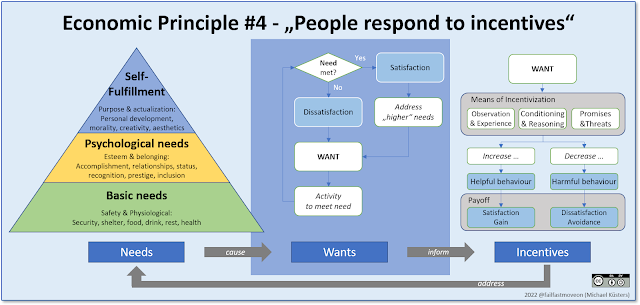
People working in bigger companies often do things which don't really seem to make sense when looking at the big picture. And yet, they're often pretty reasonable in their choices. They are intuitively following basic psychological and economical principles. Let's explore.


The economy of needs, wants and incentives

Let's start out at the detail level of the individual. Each person has needs:

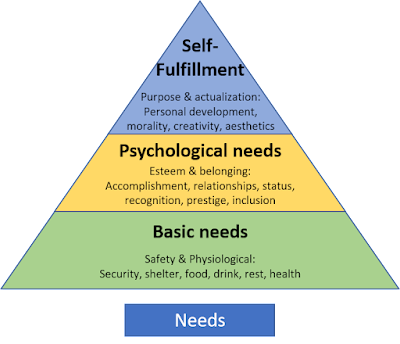
The need pyramid

Maslow's hierarchies of Needs, sometimes also called "Maslow's pyramid" is built on the theory that every human being has needs, and these needs follow a hierarchical order. This picture is already a simplification, more comprehensive models are abundant on the Internet. 
While each person has the same types of needs and the pyramid is the same, the level at which these needs are considered "satisfied" widely differ. 
One person might feel basically satisfied with a bowl of rice and a few cups of water, whereas another person requires a more special diet to  sustain. These are the basic needs, which must be met to ensure survival. People whose basic needs aren't met will not have a mind to think about other things, their primary concern will always be meeting these needs.
Once people are satisfied at the basis, they care for psychological needs - family, social ties, being accepted and valued.
With such a firm foundation starts the restless search for meaning in life - developing one's personality,  being creative, pursuing a cause. At this level, people look for transcendency.
Dan Pink mentions this in his book, "Drive" - without fully realizing that it's not just that the money must be off the table, but all basic and psychological needs. People who feel threatened for their physiological well-being or social status aren't looking for transcendence, so in order to set up an organization where people go to look for a higher purpose, there's a lot of groundwork to be done in taking care of people first.


From "Need" to "Want"

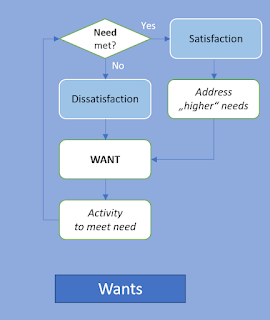
Unmet needs cause dissatisfaction with the status quo. This is also true for the future, because people think ahead.
We build our needs pyramid from the bottom, and whenever a lower-levelled needs turns to an unmet status, everything on top of that need gets out of focus. A starving person doesn't care for appreciation (many artists can tell that story.) A bullied person won't feel the office aesthetics. And so on. So, when a person has an unmet need, they want something, and action is required to satisfy the need (although it could be a different actor to serve the person in need.)
There are a lot of intermediary Wants - for example, money can be used to meet all kinds of need. When a person is hungry, they want money to buy food. Or drink. Or to pay the rent. Once basic needs are satisfied, they might invest that money to buy a token of wealth that meets their need for social recognition. And so on.
Other intermediary Wants, such as a promotion, could be more complex: Is it about the job title for prestige, is it about the presumed job security, about the additional pay, is it to rise the ranks to improve status? Maybe all - maybe only some. 
Or maybe the idea that the Want satisfies the need is an illusion?

The key takeaway here is - if there's a need, there is a want. Ignoring the underlying need will render attempts to satisfying a Want ineffective.


Incentives

Incentives don't directly affect needs. They work because they trigger (both positive and negative) wants: things the individual wants, in order to meet needs - and things the individual wants to avoid, in order to not have needs unmet.
An incentive always stimulates at least one Want. 


Positive incentives

Positive incentives give people the ability to satisfy their needs if they conduct a certain action. The most common form of positive incentive is, "Do your job, get your paycheck." Even a simple "thumbs up" from a coworker can be an incentive to try and go the extra mile. 
The strength of an incentive depends much less on the nominal amount of incentivization - much rather, it depends on the level of unmet need. For example, you won't entice Donald Trump with a Thumbs Up, but the new team member who's not certain of their position in the team yet may be willing to go great lengths to finally get the lead developer to nod in agreement of something.

Negative incentives

Just like positive incentives, we can find ourselves subject to negative incentives.  For example, the negative incentive "skip dinner"  attached to overtime plays on our Want to not be hungry.
In society, we use negative incentives to deter certain behaviours, such as fines (which affect people differently, depending on their wealth.) 
Explicitly phrasing negative incentives helps people discover which courses of actions are desirable and which are undesirable.
Managers quickly forget that there are almost always some negative incentives attached to their words: Even asking for a trivial thing might leads to the person feeling their status in front of their peers is diminished - a negative incentive, which people try to avoid.


The incentive economy

An economy is defined by wealth - in this case, we define "wealth" as satisfied needs.
In the case of incentives, we're dealing with promises of future wealth, hence, a value proposition to the recipient of the incentive.


Passive incentives

"What could be a passive incentive?" - well, that's an incentive created by doing nothing. Taking an extreme example, when a police officer continues munching donuts while a robber demands cash from the store owner, that's an incentive for the robber to commit further crimes. We see much less extreme examples in everyday's business world as managers fail to acknowledge the successes and contribution of their teams, incentivizing individuals to either cut down on performance (if stress is affecting their basic needs) - or to start hunting for a better job.

The nefarious thing about passive incentives is that you literally don't need to do anything to trigger them.

Ineffective incentives

The next type of incentives we're looking at are ineffective incentives. A positive incentive which doesn't address a real Want is entirely ineffective - as are negative incentives which don't touch a relevant need. This is also the reason why a pay raise for a person who's already fully able to meet their basic and psychological needs is pretty ineffective, as Dan Pink in his work, "Drive" figured out.
The same is true for "fun activity at work" while people are worried about not being able to afford the rent: it affects a higher-levelled need while there are lower-levelled Wants.
We can try to manipulate people by suggesting that they do have a certain Want, a typical marketing strategy. Here we can quote Lincoln, "you can fool some of the people all of the time, and all of the people some of the time, but you can't fool all of the people all of the time." Eventually, people will realize that an incentive doesn't affect their needs, and they will ignore it. That is especially true for  things often called "non-monetary incentives."
Likewise, when a person finds alternative ways of satisfying their Needs, the Want disappears, and the incentive fizzles. For example, new joiners will stop trying to achieve the recognition of their boss when they feel that the recognition of their peers means a lot more. 

Hence, long-term incentives that have alternatives tend to be ineffective. 

Perverse incentives

The final category of incentives are perverse incentives - these are different from the other categories.
When we try to incentivize an action, we usually try to do that to get a benefit from what they do. The term, "perverse incentive" comes into play when people have the Want, but the intended incentivized action isn't actually what people to in order to meet their need, and so they go to do undesirable things. "Cobra Farming" is a notorious example of a perverse incentive.
The problem with perverse incentives is that they work extremely well - just not in the way that the incentive-giver intended. 
And there's another problem: Perverse incentives are extremely common in complex organizations where the relationship between cause and effect isn't clear.

Setting incentives without connecting to the recipient's reality often leads to perverted incentives.  
Top managers coming up with broad-brushed incentivization schemes for people at shop floor level often realize this only when it's already too late.


Summary


Bringing it all together - we have to understand the real needs and how they can be met. We must learn to go beyond merely talking about our Wants.
From there, we must learn how to take care of each other's needs in effective ways.

That allows us to become explicit on the incentives that let us build "Win-Win" scenarios.

Monday, November 1, 2021

Four key metrics for transformation effectiveness

What matters for a company in an "Agile Transformation?" Well, let me give you my perspective. Here are four key metrics which I would advise to track and improve:


Customer satisfaction

Customer Satisfaction can be both a leading and a lagging indicator. It's leading, because it informs us how likely our next move will grow our business - and it's lagging, because it tells us how well we did in the past.
We can measure it asynchronously with tools like the Net Promoter Score or observing Google ratings. Softer metrics include customer interviews. Modern, technological means include A/B tests, conversion and resubscription rates.
Regardless of which of these you measure: if you see this indicator going down, you're most likely doing something wrong.

A proper change initiative relies on being able to track user satisfaction in some way and use that to inspect and adapt accordingly.

Employee happiness

Employee happiness is a pretty strong leading indicator for potential success: happy staff tend to do everything in their power to help the company succeed, because they like being part of this success. In reverse, unhappy staff are a leading indicator for many other problems that only become visible once they hit.

I'm not a huge fan of employee morale surveys, as depending on the organizational culture, it's weaponized against management, so people always give scores of 100% and bolt for the door at the next opportunity. 
The minimum you can do is measure staff attrition - if your attrition rates are above industry, you're doing something wrong. If you're significantly below, you're probably doing something right.
At a more detailed level, it does indeed help to look at factors like psychological flow, change fatigue, diversity and compensation fairness, although we need to be careful that these are used as indicators for inspection and adaptation, not as the next management KPI to be gamed.
 

Throughput rate

Throughput rate is a leading indicator for capability and capacity: when you know your throughput rate and the amount of work ahead, you can well predict what happens when.

The effectiveness of an organization can be tracked by looking at end-to-end throughput rates of the core value streams. Some examples are the duration from lead to conversion, from demand to delivery, or from order to cash.
Take a look at queues, lack of priority, overburdened employees and unavailable resources. By tweaking these levers, throughput rate can often be doubled or more, without any additional effort or expense.
Although it may seem counter-intuitive: the key is not to get people to "work harder," it is to eliminate wait time by having some people do less work. For that, we must understand where wait time accumulates and why it does so.


Financial Throughput

The proof in the pudding is financial throughput, a lagging indicator. Be wary - it can't be measured by department, and it can't be measured by unit. It also can't be measured exclusively by looking at the cost sheet and the amount of work done.
Financial throughput is the one key metric that determines business success: it's the rate at which we're earning money!
We have two significant levers for financial throughput: speeding up the rate at which we turn investment into returns, and reducing the size of the investments such as to bind less capital. Ultimately, combining both of these is the sweet spot.


How to improve

Customer and Employee satisfaction

These metrics depend mainly on the managerial system of the company: how goals are set, how people are treated. Usually, there's a strong correlation: happy employees make customers happy, and happy customers give positive feedback to employees.
Deming noted in his 14 points that management must work to "remove barriers that rob people of their right to pride of workmanship.

Transparency is one factor, getting out of the way is another. Removing policies that reduce people's ability to do the right thing is yet another. A management committed to quality, that is, fixing things that lead to poor outcomes, is vital here.
And, of course, the ultimate key here is letting people own their process.

Throughput rate

This third metric depends on flow efficiency. 
Note that "flow efficiency" is not "resource efficiency:" A process where people and/or resources operate without slack is usually dysfunctional and will falter at the slightest hiccup. Process flow requires resilience. 
Queues are a universal killer of throughput rate, so avoid queues wherever and whenever possible.

In software engineering, process efficiency is mainly determined by engineering practice: Software Craftsmanship and Continuous Delivery (CD). The prior requires people to know how to develop software using the most appropriate techniques, such as Clean Code practice. The latter requires some tooling, a product architected for CD, a high commitment to quality as well as policies and practices consistent with the intent of CD.


Financial Throughput

The final metric depends on how aligned decision-makers are with their customer base and their organization.

While financial throughput relies on the organization's operative throughput rate, we have to look at which things affect our financial throughput and enable our organization to do more of these - and quicker. And in many cases, that means doing less of the things that have sub-optimal financial throughput. For example, eliminating "failure demand." (work that's only required because something else went wrong.) Or "null objectives." (targets which do not affect these four metrics.)


And how about Agile Frameworks?

Nowhere does this article mention a specific "Agile Framework." This is not an oversight - frameworks are irrelevant, or potentially even harmful, in the discussion of business relevant metrics. They could be a tool in the solution space. That depends on where we come from and which challenges we face.

For example, if we're challenged on engineering practice - we can't solve that with Scrum or SAFe.  Likewise, if we have customer satisfaction issues: Kanban doesn't even consider the topic.

Not even "Agile" is either a relevant means, nor a relevant outcome. Working "Agile" is merely one possible approach that tends to be consistent with these metrics. Where agile values, principles, practices and mindset help us improve on these metrics, they are valuable. But when that is not the case, they aren't worth pursuing.


Wednesday, March 24, 2021

The only constant is change

A classic response towards change failures in traditional organizations, most notably, Software Release failures, is "Then make changes less often." This gives a good feeling that for a prolonged period of time, things will be predictable and stable. Unfortunately, it's a local optimization issue that actually makes things worse in the long term. Why do we think like that, and why is that thought a problem?


The gut reaction

Let's say that a change just failed. This is an uncomfortable event. Naturally, we don't like discomfort. The easiest way to deal with discomfort is to postpone the re-occurrence of the uncomfortable event into the future. In software development, we do this by postponing the next release as far as possible.

This provides an immediate short-term effect on our psyche: We have just achieved certainty that until the next release happens, there will be no further discomfort, and thus we have reduced immediate stress by postponing it.

Unfortunately, this has done nothing to reduce the probability of that next change failing.

Now, let's see what happens as a consequence of this decision:


The immediate after-effect

Because there is now a prolonged period of time until our next release happens, and the amount of development work is not decreasing, the batch size for the next release increases by exactly the amount of delay in the release. So, if, for example, we used to release once per month and reduce this to once per three months, the batch size just went up 200% with a single decision.

Of course, this means that the scope of the next change is also going to increase, it will become more complex to deliver the next release.

The knock-on effect

A bigger, more complex change is more difficult to conduct and has a higher potential for failure. In consequence, we're going to be failing stronger and harder. If we have 3 small changes, and 1 of them fails, that's a failure rate of 33%. If we now combine all 3 changes into 1 big change, that means we end up with a 100% failure rate!

You see - reducing change frequency without reducing change scope automatically increases likelihood and impact of failure.

If now we decide to follow our gut instinct again, postponing the next failure event, we end up in a vicious circle where change becomes a rare, unwanted, highly painful event: We have set the foundation for a static organization that is no longer able to adapt and meet customer demands.

The outcome

The long-term consequence of reducing change frequency is that we can poorly correlate effort and outcome, it becomes indistinguishable what works and what doesn't - and thereby, the quality of our work, our product, our processes and our metrics deteriorate. We lose our reason to exist on the market: providing high quality and value to our customers on demand.


"If it hurts, do it more often."

Let's just follow the previous computation:
If 1 big change fails 100% of the time, maybe you can slice it into 3 smaller changes, of which 2 will succeed, reducing your failure rate by 66%?

So, instead of deciding to reduce change frequency, you decide to increase it?

The immediate after-effect

Because there is now a shorter period of time until the next release, there will be a reduced time between when something is developed and until you see the consequences. We close the feedback loop faster, we learn quicker what works and what doesn't. And since we tend to be wired to not do things that become painful, we do more of the things that work, and less of the things that don't.

The knock-on effect

Managing small changes is easier than managing complex change. Thereby, it becomes less risky, less work and less painful to make multiple small changes. Likewise, since we get faster (and more frequent) feedback on what worked, we can optimize faster for doing more things that provide actual value.

The outcome

By making rapid, small changes, we can quickly correlate whether we improved or worsened something, and we can respond much more flexibly towards changing circumstances. This allows us to deliver better quality and feel more confident about what we do.


Summary

The same vicious circle created by the attitude, "If we change less often, we will have fewer (but significantly more) painful events" can become a virtuous cycle if we change our attitude towards, "If we do it more often, it'll become easier and less painful each time."

Your call.

Friday, January 1, 2021

Culture Conversion

Many times, I hear that "SAFe doesn't work" both from Agile Coaches and companies who've tried it, and the reasons behind the complaint tend to boil down to a single pattern that is missing in the SAFe implementation - culture conversion. Let's explore why this pattern is so important, what it is, and how to establish it.


The Culture Clash

Many enterprises are often built upon classical management principles: Workers are seen as lazy, selfish and disposable "resources". Decisions are made at the top, execution is delegated. We have a constant tug-of-war between "The Business" and "Development". All problems are caused by "Them" (irrespective of whom you ask) - and the key objective is always to pass the next milestone lest heads roll.  There is little space for face-level exchange of ideas, mutual problem solving, growth and learning.

If you try to use an agile approach, which is built upon an entirely different set of principles, practices and beliefs, you'll get a clash. Either workers care, or they don't. Either people are valuable, or they aren't. Either they can think, or they can't. You get the idea. Behind that is a thing called "Theory X/Y." 

Self-fulfilling prophesy

When you treat people like trash, they'll stop caring about their work. When you don't listen to your developers, they fall silent. When you punish mistakes, workers become passive. And so on. This lose-lose proposition turns into a death spiral and becomes a self-fulfilling prophesy.

Likewise, when you create an environment built upon mutuality, trust and respect, people will behave differently. Except - you can't just declare it to be so, and continue sending signals that the new values are "just theoretical buzzwords that don't match our reality." Because, if you do that, this will again be a self-fulfilling prophesy.


Breaking the vicious circle

You can't change everything overnight, especially not an entire organization. Some people "get it" immediately, others take longer. Some may never get it. Even when you desire and announce a new culture, it can't be taken for granted. You have to work towards it, which can be a lot of effort when dealing with people who have built their entire careers on the ideas of the old culture.  

Resilience over robustness

A lot of this doesn't happen in the realm of processes, org charts and facts - what's truly going on happens mostly in the realm of beliefs, hopes, fears. As such, problems are often difficult to identify or pinpoint until a dangerous symptom becomes manifest. Hence, you can't simply re-design an organization to "implement" this new culture. The best you can do is institute checks and balances, early warning mechanisms, buffer zones and intentional breaking points.

Buffer Zone

Often, you may need time to collect striking evidence that would convince others to let go of certain un-helpful practices. These might include, for example, HR policies, project management or accounting practices. When you can't quite yet eliminate these things, it's quite important for the culture conversion to also include a conversion of such activities, so that they don't affect the teams. At the same time, you need a strategy laid out with clear targets for abolishing these things, lest they become "the new normal" and culture converters start believing them to be right or even essential.


The Culture Conversion Pattern

When you operate in an environment where cultural elements that conflict with the intended future culture exist and will likely interfere with the sustainability of the change, you need mechanisms that let you:

  • Establish the desirable culture
  • Minimize undesirable culture infringement
  • Mitigate damage from culture infringement
  • Breaking points when undesirable culture gets too strong
  • Identify culture clash

Specific people must take on this responsibility, it's not sufficient to say "We should do this." Someone must be in control of these activities and the entire organization must rigorously apply the above mechanisms, inspecting and adapting relentlessly upon failure.

Failure on any of these will provide a backdoor for the existing, undesirable culture to quickly usurp the new culture, and the culture change will fail.

The SAFe Zone

A healthy SAFe organization would institute the "Program Level" to provide exactly this resilience for culture conversion. The Product Management function would protect the agile organization against low value work and overburden, the RTE function would safeguard against Command and Control, and the architect would be the bulwark against unsustainable engineering. Product Owners and Scrum Masters would provide an additional safety cushion to protect the teams.

These roles must unite to drive the need for transparent, un-political value optimization, mutual collaboration and quality-focused development practice both towards the teams and the non-agile surrounding organization.


Failing Culture Conversion

Let's say your Program Level is being pressured to introduce cultural dysfunctions from the previously existing surrounding organization into the Agile Release Train, and they can't push back. In their function as a culture converter, they are now converting the new culture back into the old culture, and as such, working against the Agile Transformation. If you do not identify and deal with this issue swiftly and strongly, you're setting the fox to keep the geese: The fledgling new culture will be steamrolled by the existing culture in no time.


Summary

When you are using SAFe, ensure that the ART Roles are both willing and able to act as culture converters, and give them the support they need to function properly as such, mostly by relieving them of any and all responsibilities that relate to the "old" culture you want to abolish.

By overriding, short-ciruiting or ignoring the culture conversion function, you're dooming the culture transformation, and since the new ways of working rely on the new culture, you're going to train wreck. 

SAFe sucks when you mess up the culture conversion.