Friday, February 28, 2020

SORT Canvas - Focusing change discussions

Often, everyone in the room has a different perspective on what could and should be done, and discussions go in circles. How do you facilitate the discussion to move forward?

I have created the SORT Canvas to discuss high-impact change initiatives. Its main area of applicability is complex, systemic long-term change, i.e. organizational change initiatives. 
It can also be used for Team Retrospectives, although that's not its main focus.

This simple canvas allows you to steer discussions about change initiatives towards agreement and first results. Plan 2 hours for a full canvas session.


An example use case for the canvas might be SAFe's "Inspect and Adapt Workshop", when the trains needs to discuss more than small changes.

Discussion Ground Rules


  1. Have everyone in the room: Make sure that all parties contributing to the situation and the potential solution are in the room. This doesn't mean all people - representatives suffice.
  2. Choose a topic: Pick a single topic, and focus on that topic. Agree to de-scope topics that are only borderline relevant or unrelated.
  3. Use abstractions: Complex environments have a lot of nitty-gritty details. When discussions get into details that aren't relevant for the group as a whole, abstract.
  4. Align perspectives: Every person has a different perspective when the discussion starts. Instead of having people elaborate their own perspective, focus the discussion on "What do others need to know?" and "Where is my perspective different from that of others?" in terms of the four topics.
  5. Move sequentially: Explain the four segments of the discussion (Situation, Objectives, Roadmap, Tasks) - and decouple the steps. Do not pre-empt by jumping between the four sections. Have points in the discussion where you explicitly ask, "Can we move on to the next section?"
  6. Write it down: As early as possible, write down a point. Move as quickly as possible to answer the question, "Can we all agree on this?" - if not, make sure disagreement is heard.
  7. Stop circular discussion: When we return to a point that's already written down in the current section, stop.
  8. Clarify the goal: The goal is to come up with a common understanding of what problem we currently have, what we are going to do about it - and how that will help us reach a better state.


S - Situation

The first step is to come to a common understanding of which situation we are currently facing. Especially in larger organizations, people have vastly different perspectives - more so if they come from different departments and experience a clash of interests.

Describing the situation usually starts with a short description of either the main problem we face or the main change we want to make.

For example:

  • an initial problem description could be: "IT doesn't deliver high quality" versus "Business is too vague on Acceptance criteria". The conflict is obvious - the solution isn't.
  • an initial change description could be: "We want to move from specialist teams to cross-functional teams."

Neither of these are workable, and there are typically a lot of reasons why the situation currently is like it is. Note down the key problems, such as unwanted side effects or unfortunate long-term outcomes along the way. The description of these will help us focus the discussion for later steps.

Techniques like Five Why, CLD or Fishbones could be used to guide this discussion, although that may already be method overkill. Most discussions are sufficiently focused.

Try to get the most critical 5-10 points written down before moving on.

After describing the situation, we can choose to limit our further discussion to a subset of the situation or problem statements before moving to the next section.


O - Objectives

Captain Obvious would state, "We don't want to have those problems any more" - although that is too generic. Let's be specific on what the future would look like: which problems are gone, and how is it instead?

For example:

  • An objective describing the future state could be: "IT and business agree before implementation on what defines high quality" or "A single team has both all the competency and authority to deliver Working Software to Production"

As you noted in my example, they contain the words "and", so they are indeed more than one item, and should be separated out, for example the first item might turn into:

  • "Business agrees that the solution is of high quality when the Acceptance Criteria are met",
  • "Teams agree to deliver solutions that exactly match the Acceptance Criteria",
  • "Teams will pro-actively communicate when AC's aren't clear",
  • "Both parties will collaborate to finalize the AC's before the Sprint",
  • "When teams feel AC's previously agreed upon no longer make sense, they will seek dialogue."

Point in case: specifying an objective without "And" or "Or" ensures that different perspectives are properly discriminated, conflations are resolved - and ambiguity is clarified.

It's entirely valid to have multiple objectives: it means that the change might be more complex, or that only a few of them would be pursued in the remaining discussion.

In some cases, a single change action will create progress on multiple objectives - in that case, it's good to be broad on the objectives. Otherwise, it might be a good time to pick a subset of objectives before moving to the next section.


R - Roadmap

When we know where we stand and where we want to go, it's a good time to start asking: "How do we get from here to there?"

During this stage of the discussion, we should try to find the most effective way to proceed from the current situation to where we want to go.

Simple changes mean that it's a single change, and that would also mean the roadmap is quick and easy. If all participants agree that no intermediate action is required, that's great - and we can move already to step 4.
More likely though, you'll have to iterate and make a series of incremental changes to achieve sub-goals. 
The purpose here, again, is not to make a comprehensive plan for perfection - it's to outline the major milestones on the road to success.

Returning to our example, the roadmap could look like this:
  • "Align Definition of Done with Business"
  • "Business people actively participate in Planning"
  • "Everyone knows how to ask key questions in Planning"
  • "Acceptance Criteria are robust"
While having SMART items on the roadmap is nice, it's much more important that participants agree on the roadmap items, their value and effectiveness. We also need to ask how fast the change would proceed. If we already know that it's going to be years until the objectives are achieved, it's not even important what the items further down in the plan are - what's important is that we agree that the first two or three points are actionable.
We will inspect and adapt anyways.

T - Tasks

Once we know the key milestones on our change journey, it's important to agree on the specific next steps.
To reiterate: the purpose is not to come up with a comprehensive change plan. The purpose of this activity is to get actionable outcomes of the meeting, clear next steps that we'll work on.

When we define tasks, we first need to agree on the most critical milestones on our roadmap - what we want to achieve first, as well as that which has the highest probability to "make or break" the change. 

Here are actions to consider:
  • Moving forward quickly, i.e. "quick wins".
  • Actions that minimize change risk, i.e. "pivoting".
  • Building the groundwork for future change, i.e. "go slow to go fast".
For each action, make sure that everyone agrees they are clearly linked to the objectives and roadmap.

Once you have agreed on maybe a dozen potential actions, decide which are the first three you will tackle. Be specific on what you want to do, who will do it - and when. Ensure that people commit to taking ownership - never assign a responsible person!

The general rule applies that you can't assign tasks to people who are not in the room. What you can do is formulate tasks like "Get buy-in from <person> for <action>" and have an attendee take ownership. Once you have identified that the specific person is necessary part of the change process, they need to be part of further sessions.

Make sure there's follow-up after the meeting ends.
An approach that might come to mind for dealing with following up on the tasks might be the "POPCORN Flow".


Wrapping up

With all participants, agree that the meeting has described a relevant problem, a desirable objective, a feasible roadmap and important actions.
Agree to a future appointment to follow up for an Inspect and Adapt session where the SORT will be repeated - revisiting all four segments.


Wednesday, February 26, 2020

ART Design - and: Solving the wrong problems

It's amazing how good organizations are at solving the wrong problem, i.e. "doing the wrong thing righter". Here is a great example of how not to design an ART:


This was the outcome of a PI-Planning. Their planning Retrospective led people to conclude that "electronic tools are much better for developing a Program Board than physical boards, because the dependencies are way too difficult to correlate with all those strings floating around, falling off, getting intertwined and so on."

This Train operates based on the assumptions that they have the right ART, the right teams - and are working on the right things. Never did it cross anyone's minds that any of these assumptions might be wrong.

The wrong ART

The first question we need to ask ourselves: do we have the right Agile Release Train?
If there is an extensive dependence on people outside the Agile Release Train, or there's a massive capacity bottleneck within the ART, while people outside the ART do have capacity to do the blocked work, then we might want to slice the ART different.

The wrong teams

It's okay for teams to occasionally depend upon one another. It fosters learning and information exchange. Some Product Managers even go as far as to purposely define features in a way that "swarming" across teams allows the ART to generate value faster. When teams choose to split work  and collaborate in real time to maximize value generation, that's a plus.

What is not okay, and a clear indicator that we have the wrong teams: When no team can get any work done without relying on actions of other teams.
Even Component Teams should be able to release value straight into Production, when teams can only do piecemeal work, those are specialist teams that inhibit the flow of value.

I have seen more than once how teams, guided by experienced SPCs and insightful RTE's, have spontaneously used the PI-Planning to "disband and regroup" - reforming as teams capable of delivering end-to-end value: It's possible!

The wrong work

The above example is a clear example of what leads to doing the wrong work. With so many dependencies, "dependency management" is already a full-time job. It shouldn't be. It should be effortless.
The prime directive of dealing with dependencies is: "Minimize."

When I see two or three dependencies on a PI Planning board, I'm happy - it means, we have decent team constellations and the right skills in the teams.
When I see more than ten dependencies, I will express concerns about team constellation.
When I see more dependencies than features on the board, I would ask the ART to work on resolving their dependencies rather than figure out better ways to manage their dependencies.


Tuesday, February 25, 2020

The problem of Proxy Users

User Stories - what's a user story, what's even a user? And: Why is that important?

The definition of a "user"

User - a person who uses or operates something.
Sources: Oxford, Google
A "person" can be both an individual or a legal entity.
The specific mention of the term "person" is quite important. We will get back to that later.

There are other definitions out there, also - that have a different emphasis:
User - a person or thing that uses.
Sources: Dictionary.com, Collins Dictionary
This definition opens a different way of thinking - that "things" (physical and/or virtual objects) can be users s well.

Types of "users"

There are various types of users.

To explain them, let's take a look at this scenario:

Scenario:
A person has bank account without any deposit money.
The problem? Checks bounce on this empty account.

Here are some core types of potential users and their problems in this scenario:

CategoryDescriptionExample
End user
(Customer)
Someone whose problem is being addressed.Bank client:
Bouncing checks means there is unpaid debt.
Service ProviderAnyone who provides a service using the product.Bank:
May get calls from both their customer and the people their customer gave checks to, asking what's wrong.
Intermediary Representative of the Service Provider towards the person whose problem is being addressed.Bank clerk:
The person at the counter, answering on behalf of the bank what's happening.
ProxyRepresentative of the person whose problem is being addresed.Bank account:
A virtual entity that acts as a proxy on behalf of the customer both towards the bank and the customer's transaction partners.
DelegateActing on behalf of the person whose problem is addressed.Accountant:
Responsible for balancing the customer's finances.
AdministratorResponsible that the product or service can be used correctly. Bank IT:
Checks need to be rejected rather than processed.


Why is the discrimination between those "users" important?

Know your Users!

Users define success

For example, if you develop in-house business support software, your user is often a single company, which means you'll have an entirely different way of measuring success than if your user is a Customer on the free market (of whom there could potentially be a couple billion). And the value of your product may depend on two categories of users: the Service Provider, whose balance sheet ultimately determines whether you are building the right product - and the Intermediaries, whose use of the product determines whether you are building the product right.

Users want their problem solved

Especially in large corporations, it's easy to lose sight of what the product actually is - and who the users actually are. By solving the wrong user's problems, you run the risk of local optimization - potentially damaging the interests of your real users in the process!

For example, look at this rather typical "User Story":
As a Security Specialist, I want people to choose difficult passwords and short password renewal cycles, so that accounts stay secure.
Then, think of yourself: How would you like it if the engineering team of your favorite app would spend a month to create password rules so complex that you need a PhD in Cryptography just to be able to determine what's a valid password - and then being forced to choose a new, different password every time you log in!


Solving the right problem

Intermediaries, proxies and administrators pose requests on systems, and while their requests are undoubtedly important, they all don't help you to solve the right problem!

Compare, for example, the following two user stories:
As a bank clerk, I want to be able to see the customer's balance with a single click.
As a bank, I want to know why I'm losing customers!
And now, let's add another user story:
As a bank account, I want to let my customer know when I have no money!

Do you see the difference between those three stories?

Users who have no financial stake

The first story may have sprung up from a conversation with a real intermediary user, and it's fairly easy to know whether you are solving this problem. However, it's almost entirely disconnected from the real user's (the customer's or the bank's) problem.
Unless it just by happenchance occurs that seeing customer balance also addresses the second problem, there's a good chance that spending time with the concerns of intermediaries derails the team from relevant business objectives.

Users that don't have a voice

The second story is an existence-threatening problem. Yet the "bank" as the legal entity that gives employment to the engineering team, has no face or voice. Its true voice may be hidden behind layers of management and bureaucracy. It may be too far away from the engineers to give it relevance and too abstract to be worth touching.

Proxies have no real needs

The third story is all too common in large enterprises: Components, proxies - even API's become "users" - assuming that if we service them, we are solving a relevant problem!

There are no proxy problems

Here's an uncomfortable truth: the proxy has no problem.
It's never the proxies' problem - it's ultimately, a customer or provider problem.

Only when real users (end users and/or providers) interact in a way that requires interacting on a path that crosses the proxy, is there a real problem. And there are two ways of solving this problem: either helping the proxy to do their job better - or to eliminate the proxy's part of the process altogether.

Hidden assumptions

There are always hidden assumptions in proxy stories:
  1. The voice of the proxy echoes the voice of the unheard real user
  2. The proxy is on the critical path of transactions 
  3. The proxy is the constraint to the performance of the system
  4. A dependency on the proxy is inevitable
  5. Solving the proxy's problem is the best solution to the real probem

By accepting the "story of the proxy", which most agile teams do with little pushback or thought, we run a massive danger of sub-optimizing a solution, and limit the solution space. While this can be valid in many cases to provide focus, this begs the question: When, if not during refinement or planning, does the team spend time to think of which solution is the best to solve the most pressing problem?

Working the Constraint

The reason why I harp so strongly on the point of "proxies" and "intermediaries" versus "real users" - is that while they are on the road to creating a higher-performing system, it's nowhere automatic that improving upon their bidding improves the performance of the system.

Theory of Constraints teaches us that:
  1. Optimization outside the Constraint is - at best - ineffective.
  2. Time spent optimizing outside the Constraint is Waste.
  3. To work on the Constraint, you need to know how to optimize it.
  4. When the Constraint is operating at its capacity - elevate it!
Here's what happens when you listen to the voices of Intermediaries or Proxies as if they were the real users:
  1. You start to forget who the Real User is.
  2. You remain oblivious of how the changes you are making affect overall performance.
  3. You don't know if you're working the Constraint or somewhere else.
  4. You may institute a new Constraint on the Critical Path, worsening the system.
  5. You will miss solutions that elevate the constraint, especially if the constraint is of higher order.


Summary

It's not forbidden to have "proxies". It's just dangerous. 
To avoid the most common pitfalls, start asking:
  • Do we understand the real customer behind the problem we are solving?
  • Is the solution on the critical path to success?
  • Are we working the Constraint?
If you can't answer these questions with a clear and resounding "Yes", you're definitely in dangerous territory - and if you can answer any them with a clear "No", you may want to reconsider implementing this story to begin with!

The problem isn't as much who your user is - it's that "fake users" make you lose sight of what value is and how to create it!

Friday, January 31, 2020

Double Queues for faster Delivery

Is your organization constantly overburdened?
Do you have an endless list of tasks, and nothing seems to get finished? Are you unable to predict how long it will take for that freshly arriving work item to get done?
Here's a simple tip: Set up a "Waiting Queue" before you put anything into progress.

The Wait Queue


The idea is as simple as it is powerful:
By extending the WIP-constraint to the preparation queue, you have a fully controlled system where you can reliably measure lead time. Queuing discipline guarantees that as soon as something enters the system, we can use historic data to predict our expected delivery time.

This, in turn, allows us to set a proper SLA on our process in a very simple fashion: WIP in the system multiplied with average service time is when the average work item will be done.
This allows us to give a pretty good due date estimate on any item that crosses the system boundary.
Plus, it removes friction within the system.

Yes, Scrum does something like that

If you're familiar with Scrum, you'll say: "But that's exactly the Product Backlog!" - almost!
Scrum attempts to implement this "Waiting Queue" with the separation of the Sprint Backlog from the Product Backlog. While that is a pretty good mechanism to limit the WIP within the system, it means we're stuck with an SLA time of "1 Sprint" - not very useful when it comes to Production issues or for optimization!
By optimizing your Waiting Queue mechanics properly, you can reduce your replenishment rate to significantly below a day - which breaks the idea of "Sprint Planning" entirely: you become much more flexible, at no cost!

The Kanban Mechanics

Here's a causal loop model of what is happening:


Causal Loops

There are two causal loops in this model:

Clearing the Pipes

The first loop is negative reinforcement - moving items out of the system into the "Waiting Queue" in front of the system will accelerate the system! As odd as this may sound: keeping items out of the system as long as possible reduces their wait time!

As an illustration, think of the overcrowded restaurant - by reducing the amount of guests in the place and having them wait outside, the waiter can reach tables faster, there's less stress on the cook - which means you'll get your food faster than if you were standing between the tables, blocking the waiter's path!


Flushing Work

The second loop is positive reinforcement - reducing queues within the system reduces wait time within the system (which increases flow efficiency) - which in turn increases our ability to get stuff done - which reduces queues within the system.

How to Implement

This trick costs nothing, except having to adjust our own mental model about how we see the flow of work. You can implement it today without any actual cost in terms of reorganization, retraining, restructuring, reskilling - or whatever.
By then setting the work you permit within your system (department, team, product organization - whatever) to only what you can achieve in a reasonable period of time, you gain control over your throughput rate and will thus get much better predictability into forecasts of any type.


Footnote:
The above is just one of many powerful examples of how changing our pre-conceived mental models enables us to create better systems - at no cost, with no risk.

Tuesday, January 28, 2020

The six terminal diseases of the Agile Community

The "Manifesto for Agile Software Development" was written highly talented individuals seeking for "better ways of developing software and helping others do it." Today, "Agile" has become a 
playground for quacks of all sorts. While I am by no way saying that all agilists are like this, Agile's openness to "an infinite number of practices" has allowed really dangerous diseases to creep in. They devoid the movement of impact, dilute its meaning and will ultimately cause it to become entirely useless.


The six terminal diseases of "Agile"

In the past decade, I've seen six dangerous diseases creep into the working environment, proliferated and carried in through "Agile". Each of these diseases is dangerous to mental health, productivity and organizational survival:

Disease #1 - Infantilization of Work

"Hey, let's have some fun! Bring out the Nerf Guns! Let's give each other some Kudos cards for throwing out the trash - and don't forget to draw a cute little smilie face on the board when you've managed to complete a Task. And if y'all do great this week, we'll watch a Movie in the Office on Friday evening!" Nope. Professionals worth their salt do not go to work to do these things, and they don't want such distractions at work. They want to achieve significant outcomes, and they want to get better at doing what they do. Work should be about doing good work, and workers should be treated like adults, not like infants.
An agile working environment should let people focus on doing what they came for doing, and allow them to bring great results. While it's entirely fine to let people decide by themselves how they can perform best, bringing kindergarten to work and expecting people to join the merry crowd is a problem, not a solution!


Once we have mastered disease #1, we can introduce ...

Disease #2 - Idiocracy

Everything is easy. Everything can be learned by everyone in a couple days. Education, scholarism and expertise are worth nothing. Attend a training, read a blog article or do some Pairing - and you're an expert. There's a growing disdain for higher education, because if that PhD would mean anything, it'd only be that the person has got a "Fixed Mindset" and isn't a good cultural fit: Flexible knowledge workers can do the same job just as well, they'll just need a Sprint or two to get up to speed! 


And since we're dealing with idiots now, we can set the stage for the epic battle of ...

Disease #3 - Empiricism vs. Science

I've written about this many times - There's still something like science, and it beats unfounded "empiricism" hands down. We don't need to re-invent the Wheel. We know how certain things, like thermodynamics, electricity and data processing work. We don't need to iterate our way there to figure out how those things work in our specific context.

Empiricism is used as an  idiocratic answer from ignorance, and it's increasingly posed as a counter to scientific knowledge. Coaches don't just not point their teams to existing bodies of knowledge - they question scientifically valid practices with "Would you want to try something else, it might work even better?" The numbers don't mean anything - "In a VUCA world, we don't know until we tried." - so who needs science or scientifically proven methods? Science is just a conspiracy of people who are unwilling to adapt.


Which brings us into the glorious realm of ...

Disease #4 - Pseudoscience

There are a whole number of practices and ideas rejected by the scientific community, because they  have either failed to meet their burden of proof, or failed the test of scrutiny. Regardless, agile coaches and trainers "discover", modify - or even entirely re-invent these ideas and proclaim them as "agile practices" that are "at least worth trying". They add them into their coaching style or train others to use them. And so, these practices creep into Agile workplaces, get promoted as if they were scientifically valid, and further dilute the credibility and impact of methods that are scientifically valid.
NLP, MBTI and the law of attraction are just some of these practices growing an audience among agilists.


And what wouldn't be the next step if not ...

Disease #5 - Esoterics

Once we've got the office Feng Shui right, a Citrine crystal should be on your desk all the time to stimulate creativity and help your memory. Remember to do some Transcendental Meditation and invoke your Chakras. It will really boost your performance! If you have access to all these wonderful Agile Practices, your Agile Coach has truly done all they can!

(If you think I'm joking - you can find official, certified trainings that combine such practices with Agile Methods!)


Even though it's hard, we can still top this with ...

Disease #6 - Religion

I'll avoid the obvious self-entrapment of starting yet another discussion whether certain Agile approaches or the Agile Movement itself have already become a religion, and take it where it really hurts.
Some agile coaches use "Agile" approaches to promote their own religion - a blog article nominates their own deity as "The God of Agile" (which could be considered a rather harmless cases) - and some individuals are even bringing Mysticism, Spiritism, Animism or Shamanism into their trainings or coaching practice!

Religion is a personal thing. It's highly contentious. It doesn't help us in doing a better job, being more productive or solving meaningful problems. It simply has no place in the working environment.


The Cure

Each of these six diseases is dangerous, and in combination, their harmful effect grows exponentially. At best, consider yourself inoculated now and actively resist against letting anyone induce them into your workplace. At worst, your workplace has already contracted one or more of them.

Address them. Actively.

If you're a regular member (manager / developer etc.) of the organization that suffers from such diseases: figure out where it comes from and confront those who brought in the disease. Actively stop further contamination and start cleansing the infection from your organization.

If you're a Scrum Master or Coach and you think introducing these practices is the right thing to do: if this article doesn't make you rethink your course of action, for the best of your team: please pack your bags and get out! And no, this isn't personal - I'm not judging you as a person, just your practice.


Saturday, January 25, 2020

You shape culture - one way or the other!

Culture is the buzzword. Everyone wants a good company culture - but: how do we get that?
In complex cyber-social systems, cause and effect are often hard to separate.

The biggest problem with Culture: it's "self-healing". When someone behaves in ways that are not in line with the existing culture, that culture will "fix" the "problem" by removing the unexpected behaviour, either through assimilation (conforming the person exhibiting that behaviour to existing culture) or ostracization (eliminating the person exhibiting the behaviour from the system).

Hence, changing culture requires constant, active effort until the culture no longer responds to the change like the human body would respond to a disease.

Shaping signals

Culture is shaped through the signals sent by leaders. We can take any of the following stances on any given, newly arising or potential cultural element - which could be a behaviour, idea or even a mix thereof:

"This is not a problem" 


If the element is negative, the signal is: "You may continue". Culture is shaped to accept the element.
If the element is positive, the signal is: "It doesn't matter". It will only prevail if it doesn't conflict with an existing cultural element.

"This is a problem" 

The signal is: "You should not continue". Culture is shaped to eliminate the element.
Do this a few times to a positive element, and you can be certain that it will never pop up again.

"We are looking for this" 


If the element is negative, the signal is "The end justifies the means". Culture will shaped by those who benefit not only from this negative element, but also from other negative elements which generate similar outcomes.
If the element is positive, there's still going to be a struggle with incumbent negative cultural elements that conflict with the positive element: The message won't stick if clashing negative elements aren't actively discouraged and the positive element reinforced.

Mixed signals

If management is sending different signals on the same cultural element, this can quickly turn into an "Everything goes" mindset. People no longer care either way - which is absolutely fatal when positive cultural elements start to get ignored and people learn to take personal advantage from exploiting negative cultural elements.
Sending mixed signals is an absolute no-go: consistency is key!

Culture as a consequence of signals

Hence, to form a positive culture, top down leadership must actively and continuously take a stance:
- Reinforce positive elements
- Reject negative elements

Everything else will eventually breed cultural toxicity.

Feedback Culture

Management needs to respond to feedback, both directly and across hops.

No Feedback

The absence of feedback poses a huge risk that culture doesn't turn out as desired - at a minimum, it's already a sign that there's no sound level of transparency.

Conflicting Feedback

When there's conflicting feedback, there's a problem. And that needs to have a root cause, which needs to be explored. There must be a negative cultural element hidden somewhere causing clashes with the desired state.

Negative Feedback

When feedback is negative, then a stronger negative element is overriding the signals - and that element needs to become priority 1 focus.

Positive Feedback

If management receives positive feedback, that needs to be reinforced. The fly in the ointment: How do you know it's honest and unfiltered? Make sure that you hear what you need to hear, not what you want to hear!


Culture as a consequence of feedback

Leaders have the opportunity to deal with feedback in a number of ways. We need to be aware that our reception of feedback is as important in shaping a culture as the way we address the behaviour itself. The way we handle feedback either creates or breaks reinforcement loops.

Negative culture as a result of feedback handling


  • Entirely disregarding feedback encourages a "Free for All" culture where people do whatever suits them best and transparency gets lost.
  • Rejecting negative feedback will lead to confirmation bias, where leaders lose touch with reality.
  • Ignoring positive feedback may lead to an abolishment of existing progress as people learn "it's not that important".

Positive culture as a result of feedback handling


  • Acting upon mixed or negative feedback reinforces the idea that "someone cares", which will lead to more efforts put into improving the situation to open a way for the cultural element.
  • Acting upon positive feedback reinforces the cultural element itself.


Down the line

Pervasive top-down leadership is the key to shaping culture - because top management are the only people with the positional power to stop the proliferation of negative cultural elements and to anchor in positive cultural elements.

Top management sets the direction. Their sphere of control on the culture reaches exactly as far as their active involvement in culture. When managers inbetween send mixed or conflicting signals with the message from above, culture in their immediate sphere of control will adapt to their local influence.

Hence, it's essential for top management to ensure consistency of signals both with their immediate staff, as well as across the organization. They need to sense and respond to the signals sent by their staff on every level.

You can't not lead

"As an manager, can't I just remain neutral? I want my teams to self-organize and don't want to impose myself on them!"
The problem with neutrality is: we can't not communicate. 
Not actively acknowledging positive cultural elements sends the signal that these are not important - hence, that's actively "not shaping a positive culture".
The same goes for not actively rejecting negative cultural elements - which is actively "shaping a negative culture".

"Evil triumphs when good men do nothing" (Image source: AZ Quotes)

Make your choice - and take a stance!


Sunday, January 12, 2020

Teams: Slices, components, features - and false dichotomies

There's a massive confusion about what is a "feature team", what is a "component team" - and what is a good strategy to proceed. Consequently, many organizations follow the advice of "Agile Gurus" without reflecting on their reality. Let me bring a little bit of light into the topic.

The flawed model

You've probably seen this kind of model - the idea that "Cross-functional feature teams are able to deliver vertical slices of value". So, basically, you'd design a team where at least one team member can tick the box in each of the quadrants:

Does "Vertical slicing" mean you can do all  things on the horizontal domain on the vertical domain?
If you believe that this means you will have independent teams who can "deliver business value autonomously" - sorry to say, you've been taken for a ride! The mental model is flawed.

Here's why:
The model makes a massive assumption: that a "product" has only these dimensions. That may be a developer's (or IT person's) point of view. But - is that really true?

The hidden third dimension

Yeah, the Business - who cares about the business? Is that even important?
Yes - we forgot the business! There's a hidden third dimension in the model that adds another level of complexity. The response you'd elicit from a lawyer if you'd tell them that the Legal domain is "simple and easy to learn" would probably be quite interesting - the business domain is at least as complex as the technical domain - moreso when we're talking about international operations and get into multilateral agreements, cultural and language differences. Indeed, when we look at traditional sales organizations, we realize that just the single domain of sales often gets split across different lines.
Typical Sales splitting lines could be products, channels, markets or regions or customer segments. So, even each of the single business domains could turn out to have multiple sub-dimensions.

In large enterprises, the model is no longer two dimensional, "horizontal or vertical slices", it's multi-dimensional with a potentially incomprehensibly large amount of dimensions!
As such, we're not even making "slices" - the delivery of value would mean that we have to cut across n dimensions!

Defining your Product

Once we realize that we're crossing borders in more than two dimensions, we need to answer the question of "What is the product we're working on?"
Crossing what?
If we define "cross-functional team" as "a single team that can deliver end to end value", we need to be cross-functional in all dimensions!
Let me take, for example - a company that wants to add Widgets to their portfolio.
Widgets need to appear in search engines, on commercials, linked to the Online Shop so that people can buy them - Widget contracts need to be bullet proof both in procurement and fulfilment - Widgets need to get shipped to the buyers, who need to get charged correctly for their Widgets - have the amount collected from their account - and finally, customer service may need to settle disputes on Widget purchases. The simple "Widget" may thus require changes to a whole boatload of technical platforms, across a wide range of business processes - and there is no "end to end customer value" until all of these functions are implemented!

This, of course, begs the question:
Can a single team of developers manage all of this?
If the business processes, technology landscape and development processes are sufficiently simple, the answer may be "Yes".

And what if they aren't?
What if there are independent technical solutions for Online Shopping, retail, B2B sales, wholesale?
What if ERP doesn't happen in the CRM solution? And what if fulfilment is outsourced to a third party? All these conditions are normal in Large Enterprises.

Organizing Teams

Especially when transitioning towards an agile organization, it's important to accept current reality and learn to understand where we are, then move from there.
"You go to war with the army you have -
not with the one you'd wish to have at a later time."
- Donald Rumsfeld
Most traditional organizations are set up to optimize IT for utilization - that is, there are different departments, groups and teams to do fragmented work:


The Classic IT Model

Classic IT is typically specialized with "project groups" where an IT project manager oversees teams specialized in a subset of technical Engineering domains, and -depending on project size- also specialized in a subset of technologies.
These teams are cross-functional in no dimension and can not deliver "full slices" of anything. They do piecemeal work and depend on other teams for everything.

From here, we get into the question: "Which direction do we want to go?"


Cross-Functional Development Teams

Scrum, among other models, assumes cross-functional teams - but what Scrum actually means is "cross functional in engineering", that is - analysis, development, test, deployment and operation are done within the same team.
Re-organizing especially smaller projects into one or two cross-functional development teams who have full control over their development process "from requested to Done" across the entire project's tech stack is a simple exercise. Breaking the team boundaries also opens the door to DevOps and thus offers some performance benefits.

Technical Component Teams

The clarification of "technical component" is important for later - because there are also business components.
An alternative approach in highly fragmented organizations is to bring together teams that can do end-to-end work on technical components. Breaking the barriers between analysis, test and development for certain technologies (e.g., a Database) can already be a quantum leap forward.
The downside is that such technical component teams need to constantly communicate and synchronize with other technical component teams to deliver anything that works.

The reason why technical component teams might actually make sense: If we have monolithic components used by multiple business processes and other technical components, then we may have nobody except these component specialists who can actually work with this component.

An example would be a centralized Enterprise Database which serves as single source of truth for Campaign Management, Sales, Customer Service, ERP and Revenue Assurance.
Such components are a pain to work with, but if that's what you have - you need to work with it.
Typically, these technical components become the bottleneck in most development efforts, so regardless of the size of the technical component team, there will always be a lot of coordination, stress and blaming going on.

Business Component Teams

While certainly preferable to technical components, Business Components are the same as technical components, on a different level of abstraction: Consider, for example, an out-of-the-box CRM platform that serves as a central customer database, and provides a frontend for typical business user processes.
While IT may claim that this CRM is a "vertical slice" and "provides end to end customer value", this only works when we have an extremely narrow definition of "end to end", "customer" and "value".

A CRM company can create an entire business model out of providing a standard product with a standard User Interface and standard functions like "create user, administer account, CRUD customer, CRUD product, CRUD order" - so the CRM company can "provide end to end customer value" to their customers, that is, companies buying their solution.

The picture looks different when an enterprise buys the CRM solution and integrates it into their business landscape: a new product is configured in the Product Management Tool, product information is provided to the CRM via API, and the CRM has to offer business insight information via API to ERP, DWH - and even business partner platforms!
In this case, the entire CRM solution is merely a component of a larger ecosystem - making the CRM team not a product team, but a component team - by nothing other than a change of perspective!


End to End Value Delivery Teams

Is it feasible to simply assume that someone who was formerly a Java coding specialist for a CRM system to take coding responsibility for the python product management and ABAP ERP as well? That's not universal to answer - yet if the answer is "No", then having business component teams with end to end responsibility for a single component's stack and processes is probably already the limit.

Given this scenario, an "end to end value delivery team" would need the ability and expertise to work across a wide range of business processes, technologies and development functions. Using the initial 3D model, such a team doesn't deliver "vertical slices" - it serves "multidimensional cubes"!

While this may be a very fascinating perfection vision, when asking the question, "How do we work today - and how do we want to work tomorrow?" - most organizations are not even remotely at a level where it's a feasible option to immediately regroup into small teams that combine all development, technology and content expertise of the entire company!


The False Dichotomy of Feature Teams

Some agilists have very strong opinions about whether we should do "Feature Teams or Component Teams" - promoting the advantages of "feature teams" and listing the disadvantages of "component teams". Yet, when taking all the previous factors into play, we quickly realize that "feature team vs. component team" is a false dichotomy.

Cross-Functionality vs. Specialization

Feature Teams are Cross-Functional and Component Teams are specialized - that's easy to proclaim. What's assumed, yet never pronounced: "Feature Teams are cross-functional in development process and technology, but specialized in the business content domain."
If we look at development from different perspectives, the statement boils down to "feature teams are specialists from a business perspective - component teams are specialists from a technical perspective." Therefore, "teams are specialists" poses a false dichotomy. All teams specialize in something.

Component work vs. end-to-end customer value

Component Teams deliver piecemeal that needs to be integrated, whereas Feature Teams can deliver end-to-end customer value. Again, we have a hidden assumption: the "customer". If we consider "the customer" to be a project, then a database operations team can well claim to deliver end-to-end customer value: from installation over configuration to access management and service requests, the team does everything.

Would we agree that AWS is a component of software systems? As an Enterprise application developer, yes. As a member of Amazon, working in the AWS development unit, this component is the product! Does Amazon deliver a product with features - or are they delivering piecemeal that needs to be integrated?
We end up at the same problem as before: by assuming a different perspective, one person's "component team" may be another person's "end to end customer value delivery team". Therefore, "teams deliver end to end customer value" is yet another false dichotomy. Depending on how the customer is defined, all teams (or: no teams) deliver end-to-end customer value.

Levels of abstraction

Component Teams work only on a small portion of the Value Stream, whereas Feature Teams can deliver a Feature across the Value Stream. There's another hidden assumption: that the "Value Stream" is an absolute, and has only one definition.

Returning to our AWS example - the AWS platform is merely the technical platform of an Enterprise Platform. Suppose that Enterprise Platform spans a business process, then that platform is just a component of an Enterprise Process. And if that process is part of a Value Stream, then that process is again just a component. And that value stream may be a component of a Value Chain, ... again: component. And if that value chain is used by another company: again: component.

The bigger we perceive the system, everything we previously considered "end to end" becomes a component on the next level of abstraction. As the complexity of an Enterprise grows, there may be a myriad of abstraction layers. Eventually, it becomes impossible for any single person to even understand how many technical changes need to be made in order to provide "end to end customer value", or: vice versa - how much new "end to end customer value" can be generated by a single technical change.

Therefore: claiming that a team "delivers end to end customer value" poses even a second another false dichotomy: it assumes an organization without abstraction layers. Only when a single team has direct access both to the low-level tech stack of all components and the end customers of the value chain - only then will any team ever deliver end to end customer value.


Aligning mental models

In the dispute of "feature teams or component teams", we need to clarify some terminology, concepts and expectations - otherwise, we get nowhere.

Specialization

We have explored in depth the different potential domains of specialization: development specialists, technology specialists - and content specialists. By now adding the question of abstraction layers, we need to also answer the question of layer specialization. The term "full stack developer" assumes a developer working on the tech stack of a single business platform - not a potentially infinite array of business platforms with a potentially infinite array of tech stacks. At some point, the "full stack developer" would become a "Master of (almost) none." - and whether they'd actually be a "Jack of all trades" becomes increasingly doubtful as the stack grows.
We need to agree on what we call "specialization" and in what context we expect "generalization", lest we're potentially talking about "being everything for everyone".

"We can't do everything for everyone everywhere, but we can do something for someone somewhere."
- Richard L. Evans

End to End Work

When we talk about end-to-end, we have different concepts, and things become difficult from there.
A really obvious example is the difference in definitions of "lead time". Whereas the common Lean understanding is that it's the time between initiation and completion of a process - this gets defined differently. While most IT project managers would calculate "lead time" as the time between when a development project gets approved and closed, the book "Accelerate" defines "lead time" as the time between "code committed" and "code deployed on Production".
Returning from the specific idea of "lead time" - one person may define "end to end" as "from customer to customer", another as "from request to delivery", another as "from development to deployment", and yet another as "from build to production".
We need to agree on the definition of "end to end", to make any discussion around "end to end teams" meaningful.

Components

We have already exhausted the subject of abstraction levels. While Software Vendors deliver certain Products, these products are just components of bigger enterprise architectures. Software Integrators do nothing other than customize and integrate one of more of these "products" into a software landscape. And even an entire array of vendor products, fully integrated into a business process - may be seen as but a component of a larger value stream.
It's irrelevant of how many layers of abstraction we have in an organization - everything one layer below is a "component". By adding one abstraction layer, every "product" turns into a "component".
We need to agree on the abstraction level we're talking about, otherwise every discussion around "component vs. product" is entirely futile.

Systems

I have painstakingly avoided the term "system" wherever possible here. The reason: everyone has a different understanding of what "The System" is supposed to be!
When we're talking about "The System", do we mean a piece of software? Do we mean the larger architectural context within which this piece of software operates, its integration context? Or do we mean the development organization developing (and integrating) said software? How about abstraction layers? How would "the system" look like at another abstraction layer?
It's common that a developer means "the piece of code that's running on a server" when they use the term "the system" - whereas a business user might consider a complex, b2b mesh of services encapsulated by a single frontend to be "the system". A systems thinker would abhor both ideas, and would equally include processes, rules and people into "the system".
We need to agree on a common understanding of "the system", lest different understandings generate confusion and misunderstanding.

Complexity

When deciding whether a team is doing simple, complicated or complex work - we're quickly falling into the trap of category errors, because "complexity", like "end to end", depends on the domains we consider. Software development is pretty simple for a single piece of content and in a single technology. As we cross technology boundaries, a simple feature can quickly become a monstrosity of technical complexity - and as we cross content boundaries, possibly even organizational boundaries - even technically simple changes can become infinitely complex.
The problem: Until we have decided the dimensions in which we assume linearity and the dimensions in which we have variation, we do not understand how much complexity we're actually dealing with!
Whereas common sense dictates that "complexity" needs to consider all relevant dimensions, these dimensions can become infinite - making everything so complex that the very word becomes meaningless!
We need to agree to what we call "complexity" - and what we don't.


Bringing the right people together

After much philosophical ado, we can use all of the above to determine how to organize teams.

A team is able to work with minimal constraints if it is:
  1. Appropriately specialized, i.e. they don't rely on third parties for knowledge
  2. Doing end-to-end work, i.e. don't have handovers as part of their process
  3. Able to work on all relevant components, i.e. don't give or receive "orders" for component work
  4. Autonomous within the overarching System, i.e. team performance depends on the team and not outside factors.
  5. Feasibly complex, i.e. given the complexity of all relevant domains and the cumulative skills of all team members, there's a realistic learning curve
Will the outcome of these five factors be a "feature team" or a "component team"?
Back to square one - that's a false dichotomy. And it's the wrong question.
In most organizations, it will be a huge struggle and steep learning journey to form such teams, and it's entirely moot to discuss how we label them. 

Before even considering whether we should re-organize, we should ponder whether any of the above five factors is currently the hindering constraint in organizational performance.

If, instead of all of these, the performance constraint rests outside the current teams - for example, in policies and procedures, in politics or processes, in budget or timelines - then it's entirely irrelevant how teams are organized, as even the "ideal feature team" would still suffer from the same constraints.

Conclusion

The entire discussion of "feature teams or component teams" is a red herring.

Reorganizing teams is only relevant if it elevates the current constraint - and the question is not whether it should be a "proper Feature Team" or whether "component teams have dependencies". 
The right question is: "will the reorganization elevate the constraint on the current system?" - only if that is the case, then will the new team structure generate any better outcomes than the previous structure! 

Hence: Work on your systemic constraints. Bring those people together who can elevate the constraint. Just let people work until the team structure is the constraint! And don't assume it is until you have supporting evidence!

Thursday, January 2, 2020

10 signs you should fire your developers

Good developers are worth their weight in gold, and quite literally so. On the downside, bad software will eventually kill your business. In this article, I will describe - from a management perspectice - ten surefire signs that you're better off firing your developers than keeping them.

At the same time, if you're a developer and you see these signs in yourself or your coworkers, today may be a great day to hand in your two weeks' notice and find a proper developer job. You're doing yourself a favor by taking the first step!

The following list are epitomes of an organizational culture which will eventually result in a steaming pile of garbage that is both worthless and expensive rather than software which lets the company flourish. Systems generated in such a culture are parasites - they suck the very life essence out of everyone who has to deal with them, and the longer you let them fester, the bigger the problems will become.


Ten signs you should fire your developers


#1 - Working 9 to 5

Creative work can't be clocked. When developers always start at a fixed time and always drop the pen at the same fixed time, never taking work home, that's a huge red flag. Sometimes, the best ideas happen while jogging, under the shower or even while playing a game. Most work doesn't happen at work - solutions created exclusively on the clock just plain suck.

#2 - Copy Paste Solutions

Software development is creating new solutions and optimizing existing solutions. By copying and modifying the same thing all the time, complexity grows over time and simple changes eventually become extremely difficult. This way of working is unsustainable, and by the time this becomes obvious, it may be economically impossible to change course.

#3 - Need for supervision

Developers need to think by themselves. When developers only do what they have explicitly been assigned to do, only work when someone is checking on them and outcomes need to be monitored before they can be released, you have a serious problem.

#4 - Closed groups

The world is bigger than we think. When developers dig trenches to the business, can't even give you the name of a single user, much less having a professional relationship with any of them - how can they build the right product? A sense of "stranger danger" where developers perceive every new face as a threat means that they have already lost touch with reality.

#5 - One Trick Ponies

"If the only tool you know is a hammer, every problem looks like a nail".
When developers see technical diversity as a threat, can only work within a single paradigm and start to frame business problems in terms of what they know rather than expanding their knowledge to suit the business domain, you have the wrong people. Combined with a "my way or the highway" attitude, you can be certain that the money you sink into development exceeds the value generated.

#6 - Learning passivity

Knowledge work is all about knowledge. A continuous hunger for new knowledge allows developers to excel in their field. When developers resist new ideas, need to be told when they need to learn something new and shy away from experimenting, they lose their edge - and so does your software!

#7 - Limits to responsibility

Great people care for what they do, and want their work to make an impact. Statements like "Works as Designed", "Works as Requested", "Quality is a tester's job" or a pervasive mindset that users are just too stupid to use the software properly imply that developers have locked themselves into an ivory tower and try to shelter themselves from reality.

# 8 - Frameworks frame thoughts

If there were a standard framework for your business, someone else would be doing it better and cheaper than you could. Be very suspicious when the answer to every question is, "<this framework> can do it", especially when the solution always looks like the framework says it has to. Once developers have a standard of standards for developing new solutions, you know they're solving the wrong problems.

#9 - Enamored with code

Nobody cares what happens "under the hood", as long as the engine runs. When developers esteem good-looking code higher than the business utility of said code, they waste time and money. Combined with an attitude that the code would look much better if it wasn't for constantly changing business demands, you know that eventually, the house of cards will collapse - and your business might tumble down with it.

#10 - Caught in the past

The marginal value of every technology is Zero. Yesterday's great solution is often just barely useful today, and last decade's state of art is today's liability. If your newest technology is half a decade old, and the "never change a running system" mindset pervades the organization, you're riding a dead horse already. If on top of that, developers feel emotionally attached to "their baby" and aren't willing to let go, you'll be stuck between a rock and a hard place.


Toxic culture

Encouraging and reinforcing the behaviours above creates a devastating culture. If you encourage behaviours that fall into any of the above ten categories, you are creating a culture where high performance isn't even possible. You may likewise inadvertently be shaping culture by not stopping these behaviours, not calling them out or just tagging along with them. As such, it's always a people problem, that is - a problem created by management.
You can't close a blind eye to these. You have to call them out, you have stop them, and you have to actively work against them. There's a reason why people do these things - and rarely is the reason that people want to hurt the business or their own career. Explore the root cause, and eliminate it!

Organizations where development works as above are career dead ends. They take the purpose out of the work and make IT as a whole a massive liability. The faster developers leave such a place, the better it is for them. If they no longer have the will to take this step by themselves, do them a favor and help them move towards a better future.


Sunday, December 29, 2019

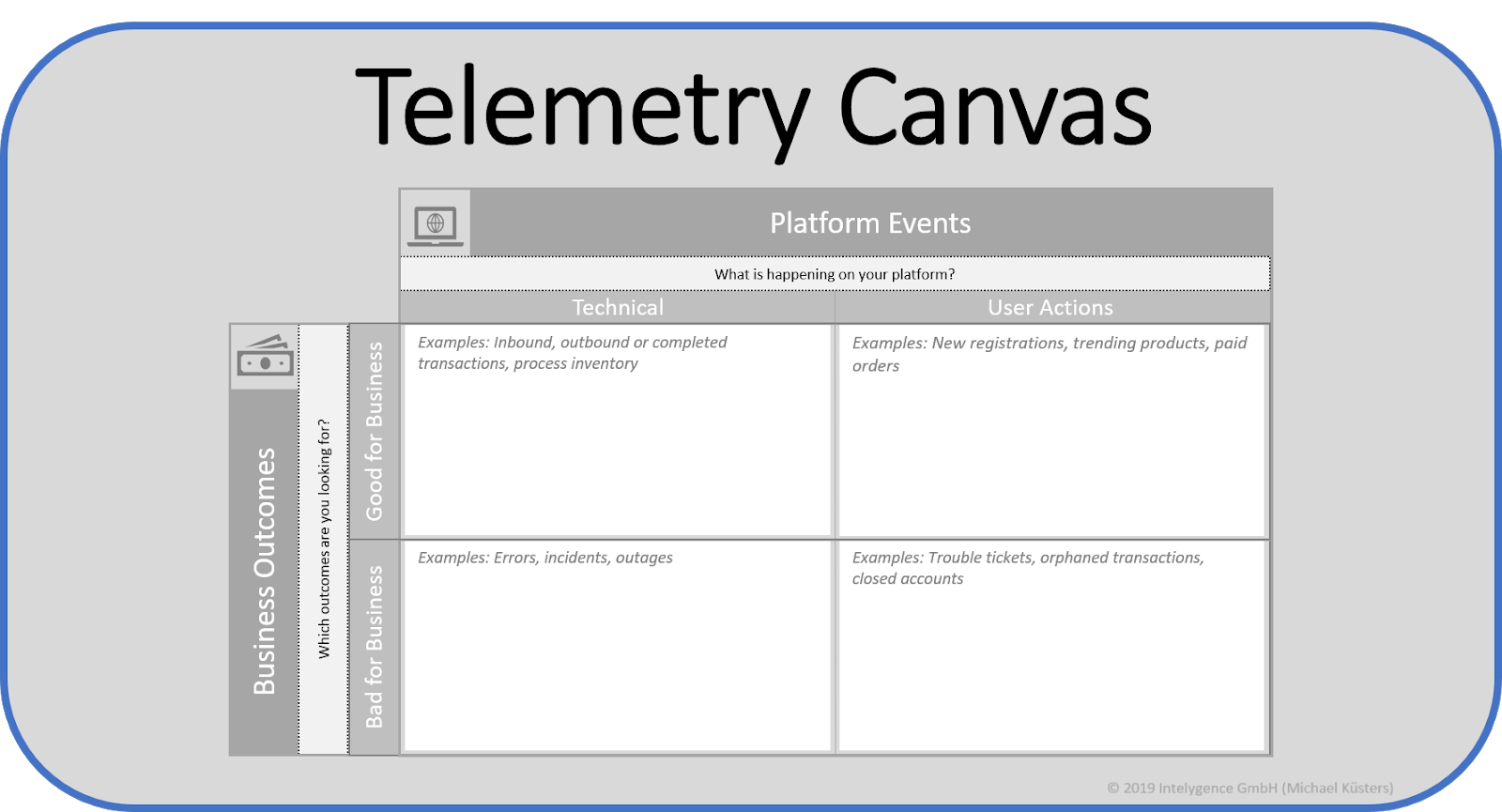
Telemetry Canvas - figuring out the right metrics

To create transparency for the key information about your company, your system, your product - you need to align your metrics. Here is a simple canvas that can help you sort your thoughts and start your journey to data driven decision making:


The Telemetry Canvas


The canvas is simple to understand. There are two main dimensions:

Events

In an IT platform, there are mainly two types of events: Those created, conducted, orchestrated, managed or performed by automation - and those performed by humans (platform users).
Anyone whose work is affected by events should have a say in defining the most relevant items for their work.

Technical events

Everything the system and/or platform does by itself, or in support of user activity, is a technical event. We can measure technical factors such as incoming or completed transactions, inventory levels et cetera. Of course, we can categorize these by transaction type, technical component or business scenario, depending on what we are looking for.

Quality checks, build failures or network alerts are also technical events that occur frequently, and require attention.


User actions

Whatever users do may also be relevant to the performance of our organizations. If our goal is to grow our userbase, new registrations are a great metric to look at. On a marketing campaign, the next logical extension would be lead conversions. Or trending products. We might also look at revenue generation - and whatever has an impact on things we care for.
Even abandoning our product is relevant for our business performance, and can be classified as "action by inaction", potentially being a relevant user action.


Business outcomes

Events by themselves are meaningless. They derive their meaning by their impact on our business.

Good for business

We are looking for certain events, such as the successful start or completion of a transaction or the generation of revenue. Many of these events fall into the category of "The more, the merrier". The best events are those that cause no work, yet generate profits.

Bad for business

Some events are always bad news, for example complaints, technical errors or system outages. Even if nobody likes to have these, they are part of working reality, and we need to pay attention to the effort we sink into them.
In many organizations, the invisibility of the "bad news" metrics on the radar causes the organization to accumulate technical debt that may eventually kill the product or even the entire company!
The best businesses aren't those who successfully ignore the bad news - it's those who know that they have less bad news to handle than they can stomach!

Deriving metrics

Once we know which events we're looking at, we can determine how we measure them.
For example: When a transaction arrives in the system - we also want to know when it is completed: we measure not just our transaction rate and inventory, we need to know the throughput rate as well. This gives us visibility into whether we're accumulating or reducing backlog, whether we're sustainable or unsustainable!


Optimization

Once we have defined our metrics, we can set optimization goals. Some events are good for our business, others are bad. The general optimization direction is either "lower is good" or "higher is good". In rare cases, we have range thresholds, where neither too high nor too low is desirable.

The easiest way is to start by capturing data on the current state of a metric, then answering the question: "Is this a problem? If so, how big is it?" - determining whether the current value is good, acceptable or inacceptable.


Using the Telemetry Canvas

The canvas is a discussion facilitation tool, so don't use it on your own.

Step 1: Invite stakeholders

Bring all stakeholders in your product together, preferably not all, but representatives from each group. This is a non-exhaustive list of people you might want to involve:

  • Salespeople, who generate income from the product
  • Marketeers, who drive the product's growth
  • Finance, who validate the product's revenue
  • Developers, who build the solution
  • Operations, who have to deal with the live system
  • Customer Service, who have to deal with those who bought it
  • UX, who design the next step
  • Legal, who definitely don't like to have trouble with the product

The more of these functions rest within your team, the easier this exercise will be - although typically, most will be located somewhere else in the organization.

Step 2: Brainstorm events

Give everyone the opportunity to draft up events that are important to their work. There is no "right" or "wrong" at this stage, and there are no priorities, either.
It's important to remember that not all events occur within the platform, some occur around the platform, and that some events can also be caused by inaction.

Get people to write each event on sticky notes.

Step 3: Locate events on the matrix

People tend to have a pretty good understanding whether an event is good or bad, so where to place the event on the vertical should be easy. In some cases, it's unclear whether an event is good or bad - then default to "Bad", because every event means data processing and work, and work that's not good is probably a bad thing.

Likewise, define the horizontal category. In some complex systems, it's unclear whether it's a user action or a technical event. Try defaulting to "user action" - you haven't discussed where to get the data from, anyway.

Step 4: Define measurement systems

As events themselves are of no value, we need to define the measurements that we want to derive from events. These can also be combination metrics, such as "Lead Time" or "Inventory Growth". What matters is that everyone in the room can agree on what would be measured.

Write each of the measurements onto post-its and put them into the field corresponding to one of the event(s) they rely on.

Step 5: Prioritize

Not all metrics are sufficiently important. Let each stakeholder name up to three metrics that matter to them - you still need to put work into setting up data collection, and it doesn't help you to have five hundred things on your "toDo" list. 
This is not a point-based system, so it's not about dot-voting, so you end up with a bunch of individual priorities. 
Although it's good if multiple stakeholders value the same metrics, since that reduces complexity, it's not necessary that stakeholders agree on the value and importance of metrics.

Step 6: Validate

You should have a number of metrics in each quadrant now. If you're missing one of the quadrants, your measurement system is probably biased. Should that be the case, ask, "What are we missing?" Try reprioritizing metrics until you have at least two in each segment.

Step 7: Agree and align

Get everyone to agree that they have their most important metrics on the canvas. Address potential concerns. If necessary, re-iterate that this is not intended to replace current measurement systems nor a final version - it's just the beginning of a journey to align on data transparency.

Step 8: Invite for follow-ups

Once the metrics are agreed, let everyone know that there will be different sessions to define the metrics in more details, that is: how the data will be collected, how it will be interpreted and how it will be represented. This consumes more time and is not in full detail interesting for everyone.

Step 9: Agree on Next Steps

The Canvas is ready, but it's just a canvas. Make sure you have an action plan of what will happen next. Here's what is suggested:
1. followup sesssions for defining the metrics,
2. do some implementation work to measure them,
3. present the metrics in a Review,
4. start using the available metrics in decision making,
5. Inspect, Adapt and Improve.

Joint Metrics - aligning business and development

"How do we bring business and development closer together?" - the key is to create transparency into what others see.

Start the discussion about what you should make transparent, so that everyone can draw the same conclusions. Making both technological and business information visible to everyone in real time will help you cut down a lot of pointless discussions about the best course of action.


Everybody is right!

Every person has their perspective of what is the most important thing, and often, each perspective is valid. For example, a technical person will consider that technological stability and high quality code are important. Salespeople care for neither - they want to close as many good deals as fast as possible. People in service support feel stuck with tons of trouble tickets, social media marketers want campaigns to go viral. And the CEO just wants a smooth, expansive operation.

A developer can only use their time once. So - what should they focus on? How can a Product Owner know whether it's more important to boost sales or to fix defects?

Classic HIPPO Prioritization

Most organizations prioritize activities like this: Either we do the thing demanded by the person who shouts loudest, or the Highest Paid Person will give their opinion on what should be done ("HIPPO Priority").

Unfortunately, neither the people with the loudest voice, nor those with the highest paycheck, tend to have a full understanding on the implications of their demand. Follow the HIPPO, and everyone else will be unhappy. Disregard the HIPPO and risk being laid off.
Either way, the organization gets stuck under the tyranny of the Urgent - shifting attention between a series of disasters and escalations to fix.
There is no freedom to think of the Big Picture, maximize business value or consider what will happen a few years down the line.

A systemic view is needed

In a healthy organization, developers in their right mind wouldn't want sales to fail - and marketing wouldn't want the technology to fail. They are often simply unaware why their personal goals have such drastic consequences elsewhere!

The solution requires overarching transparency, laying all the cards on the table.
 In most modern organizations, there is some kind of data that people utilize, yet everyone gathers their data from a different source and interprets it in their local context. This is not to advocate a central Data Warehouse, Master Data Management or a specific data representation tool here - the problem can't be fixed technologically: A sysop would look at logfiles, developers at source code, sales at transaction records and marketing at campaign information.

None of the data is related on the surface. Yet, in a closed system, all of these are sides of the same coin (probably, an "infinity dice" would be a more applicable metaphor).

Breaking the local optimization

Every stakeholder can define metrics for their specific area of expertise. Sales is very adept in defining what is great, what's okay and what is intolerable when it comes to closing deals. Hence, it's very easy for them to define a metrical system that creates overall visibility on how healthy sales are. Developers can do the same for their systems, finance for revenue - and so on.

And then we lay all of this information on the table. When everyone has a say in what we're looking at, we have objectivity in whether we're doing great, alright or meh in the big picture. And make it visible to everyone.

Bringing the puzzle together

Imagine you log into your company account - and the first thing you see is where your company is doing great - and where it just plain sucks. From the customer service rep, all the way to the CEO, from technology to business, everyone will have at their fingertip the information where your biggest strength and where your biggest weakness is.

It will become very intuitive and easy to make key decisions, and even when diplomatic compromize is needed, people will at least understand the impact of their choices.

Leaving the hamster wheel

Many organizations are challenged to break free from the hamster wheel of tasks and activities. Product evolution is often nothing more than putting band-aids on cracked pavement. Systems are fundamentally broken, because it's all about meeting short-term goals, and rarely about larger long-term beneficial change. The future gets sacrificed for today's needs.

Planning strategically

We need to figure out where we're constantly fire-fighting, where we're in calm waters, and which problems correlate. We can use the transparency of the data to introduce measurable strategic objectives, such as, "reduce technical debt from 50000 years to 100 years", or "increase conversion rate from 1.2% to 2%". It's totally valid to have multiple strategies with multiple objectives and multiple targets in place at the same time.

Building empathy

Another great advantage of building a common metric portfolio for everyone in the organization is that we start to get empathy for one another. Developers see when sales is struggling, marketing realizes when development is drowning. The discussion moves away from "What do I need next?" towards "Who has the biggest problem and how can we contribute to improvement?"


Friday, December 13, 2019

The nonsense called "Enterprise Agile Development"


The "Manifesto for Agile Software Development" is the basis for many "agile approaches". Enterprises worldwide have been sold to the idea that they need to become "Agile" in order to remain competitive. And anecdotal evidence of the success of "Agile" is abundant.

There's a dirty little secret that most organizations, coaches and consultants are either unaware of, don't understand - or they just don't realize the impact thereof: "Agile", as originally proposed, is a local optimization, intended to improve the work of software developers! This begs the question: "What if Software Development isn't even the problem?"

Synopsis

If we look at organizational processes from end to end, we realize that even if Product Development were a flawless, instantaneous activity, not much would be different in the big picture. Why do we spend so much time and energy to make irrelevant changes?
95% of changes made by management today make no improvement. -Peter Scholtes
"Agile Transformation" is often one of these ineffective changes.
To find a better solution, we need to frame the problem differently.

The scope of "Agile"

"Agile" is intended to bring the entire IT development organization together. It's irrelevant whether we're talking Scrum, Crystal, XP or whatever, this idea is fundamental to "Agile".
From the time a "requirement" (or: "user story" - or whatever) is scoped for delivery until it's delivered, people from IT collaborate, involving business stakeholders, to minimize cost, overhead, quality risks and delay in the process.

Why "Agile" looks so appealing!
It sounds very appealing to any IT manager worldwide to reduce defect rates, cost and cycle times by margins of fifty percent plus each, while making IT employees happier, especially since those benefits can actually be achieved compared to siloed approaches!

But what if I told you that none of this matters at enterprise level?

The real picture

In a 100.000+ people enterprise, there are hierarchies, reporting lines, budgets and highly complex dynamics going on. Not everyone talks to everyone else.
In an enterprise context, it's fairly normal that from idea until approval, different rounds of experts, stakeholders and boards are involved - long before an item lands in IT's actual toDo list.

The idea goes through some kind of process, where people who are not involved in actual development clarify what's actually going on, whether it's worth doing and have to make sure it will get done.

While Scrum specifically has a "Product Owner" and Scrum proponents might argue that this is "refinement" for which the Product Owner has this responsibility - in an enterprise, that's too much work for one person, so it will be delegated: We end up with handovers in the process, multiple queues and waiting lines. 

This picture depicts what's actually going on in most larger organizations:

Careful - "Agile" doesn't even talk about the big picture!

The lead time of the yellow chevrons, in a Waterfall world, tends to be 3-6 months, and in an Agile universe, it's much shorter. 

Let's do a thought experiment: What if the yellow part of the process were conducted by a little fairy with a magic wand that could complete all these activities at zero cost, in zero time and without any defects? 

How agile, how fast, how cheap would this process now be?
In large enterprises, each of the gray chevrons takes weeks to months, is quite expensive and error-prone. Considering the end to end process chain, even if we disregarded everything happening in the "Agile" parts of the process - we'd still have a slow, inflexible and expensive process! 
The overall effect of introducing "Agile Software Development" into Enterprise processes is neglegible.

End-to-end Agility

Now, we get to the revolutionary idea of simplifying the entire process by means of moving to "Business Agility": bringing developers straight to the users!

A paradigm shift: entirely removing the men-in-the-middle!
Once an item is prioritized, we jump straight into development. There's just a small fly in the ointment: how do we prioritize it? In order to determine whether it's the most valuable thing, it still needs to be refined - so the same process still applies!

The problem, unfortunately, in the Enterprise world, is not even whether we have a handover in the process between a "Refinement Team" and a "Development Team". The real problem is overall lead time!

As long as it takes weeks to do the clarification rounds, the umpteen mandatory boards only meet once in a full moon, every new feature requires comprehensive user trainings and there are manual compliance audits, there is no way for a change in development to significantly affect overall outcomes!
Unless you're part of the problem, you're not part of the solution.

The illusion of improvement

When overall processes retain their massive overhead, and communication structures remain untouched, Agile Development alone is irrelevant to the overall business outcomes. Even if we get it right - which is extremely hard in the governance straight jacket so nicely provided by many organizations - the enterprise as a whole will not feel much of an impact by the introduction of "Agile Development" into a cluttered, overcomplicated jungle of processes, rules and regulations.

If we are looking for significant improvements to the enterprise, Software Development is often not the right place to look - yet agilists have spent nearly a decade developing increasingly intricate ideas for optimizing exclusively this part!

Moving Enterprise Software Development from "Waterfall" to "Agile"  is like using white sand instead of yellow sand to mix concrete - we feel as if we made a difference, while an outside observer wouldn't recognize any change!

And that's why Enterprises who have invested heavily into "Agile Software Development" often feel underwhelmed with the outcome and become entirely disillusioned.

A change in mindset

"Agile" brought a massive change in mindset, it gave developers a voice - and it's people from Technology who are now educating the business world how to change their ways of working, in order to take advantage of Agile processes.
Unfortunately, we see that many agilists are stuck in their little Technology world, not realizing that optimizations made exclusively from a Technology perspective alone are exactly as ineffective - and potentially equally harmful - as those made by Finance (namely, Cost Accounting - but that's another story, to be told another time).

Much more important than doing an "Agile Transformation" and converting legions of decently functioning teams with decently performing individuals to "Agile ways of working" would be to look at the real problem the organization is facing - it's not a development problem. It's a flow problem, in end to end value.

I believe that not just agilists, but struggling organizations as a whole, will find significant value in moving beyond the new structure and processes suggested by Agile Frameworks and tackle the real issues their organization is facing, which are hidden in plain sight when adopting Agile Frameworks.

In the past years, I have come to realize that we need to move beyond IT, beyond Technology, beyond Product Development, to see the need for a Unity of Purpose, optimization at the bottleneck and relentless improvement. Try not making any change to anything other than the bottleneck: Development can work however they consider fit, unless and until that's where the bottleneck is.


Closing remarks

Let's just not make changes that don't matter. Too much harm and grievance has been inflicted upon managers, developers and entire organizations in the name of this "better way of working". So many "Agile Transformations" caused great people to lose their job, their sanity or the respect they deserve, while giving the organization nothing to show in return. It's time to stop this madness.

Let's put Agile Frameworks where they perform best: into Product Development. Let's not try to stretch their purpose beyond their applicability, and let's not overzealously convert everyone to one specific way of working. Give people the freedom to work in whatever way they consider is best for them, Offer people Scrum, Kanban, SAFe or LeSS as an option if it makes them happier - but don't force anyone into any of this, especially not when development isn't even the problem.